| Reading Time: 12 minutes
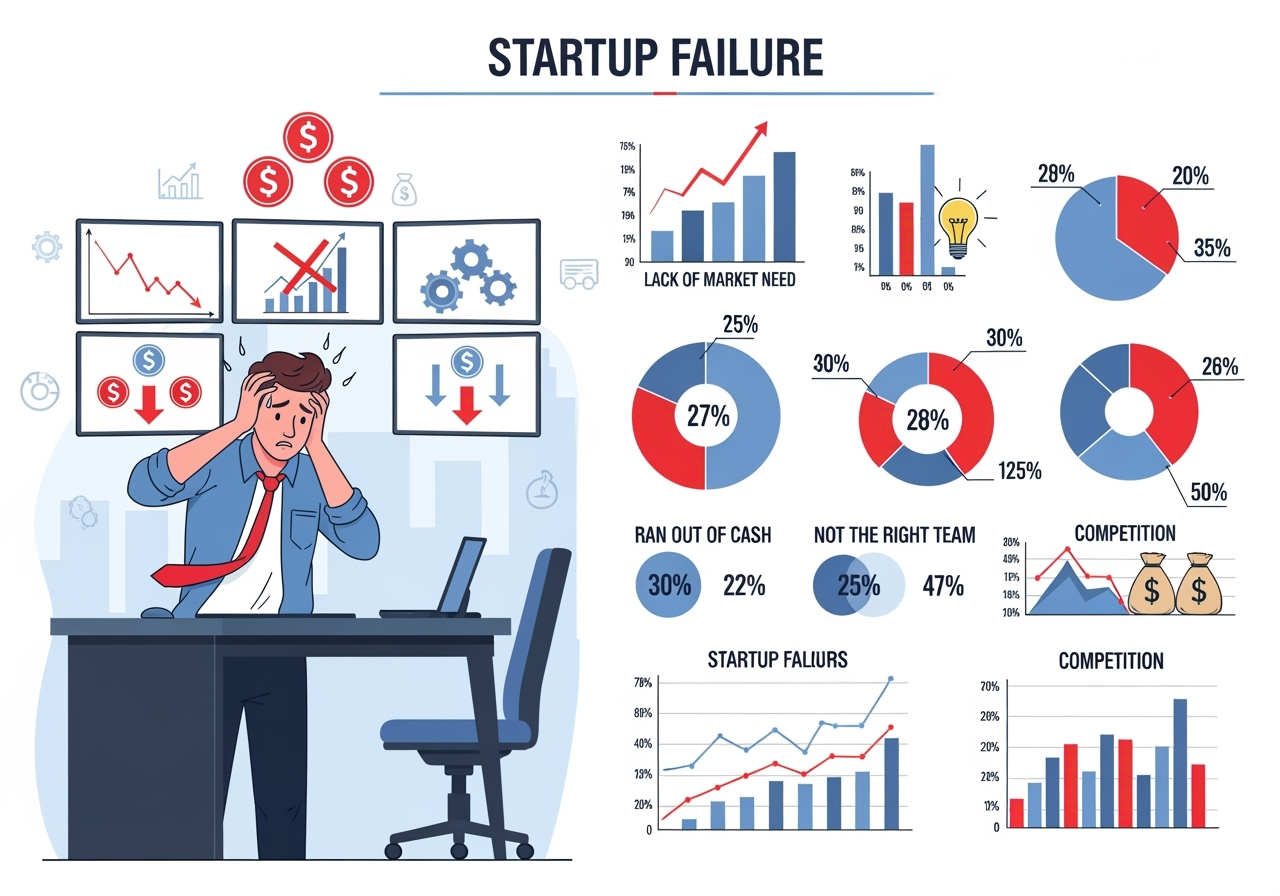
The statistics are sobering: according to recent data from the Small Business Administration, approximately 73% of US startups struggle significantly with their digital marketing efforts, with many failing entirely within their first two years due to marketing-related challenges.
But here's what most entrepreneurs don't realize: the problem isn't lack of budget or market demand. It's the fundamental approach to digital marketing that's broken—and artificial intelligence is providing the solution that could save your startup.
Table of Contents
- The $2.3 Trillion Problem
- The 7 Fatal Marketing Mistakes
- How AI is Revolutionizing Startup Marketing
- Real Success Stories
- Implementation Framework
- Getting Started Today
The $2.3 Trillion Problem {#the-problem}
The US startup ecosystem generates over $2.3 trillion annually, yet Harvard Business Review reports that marketing failures account for 42% of startup closures—more than funding issues or product-market fit problems.
The Hidden Costs of Marketing Failure
When startups fail at digital marketing, the ripple effects are devastating:
- Customer Acquisition Cost (CAC) increases by 300-500%
- Time to market extends by 6-18 months
- Investor confidence plummets, affecting future funding rounds
- Team morale suffers, leading to talent exodus
According to CB Insights, the average startup spends $50,000-$200,000 on failed marketing initiatives before pivoting or shutting down.
The 7 Fatal Marketing Mistakes US Startups Make {#fatal-mistakes}
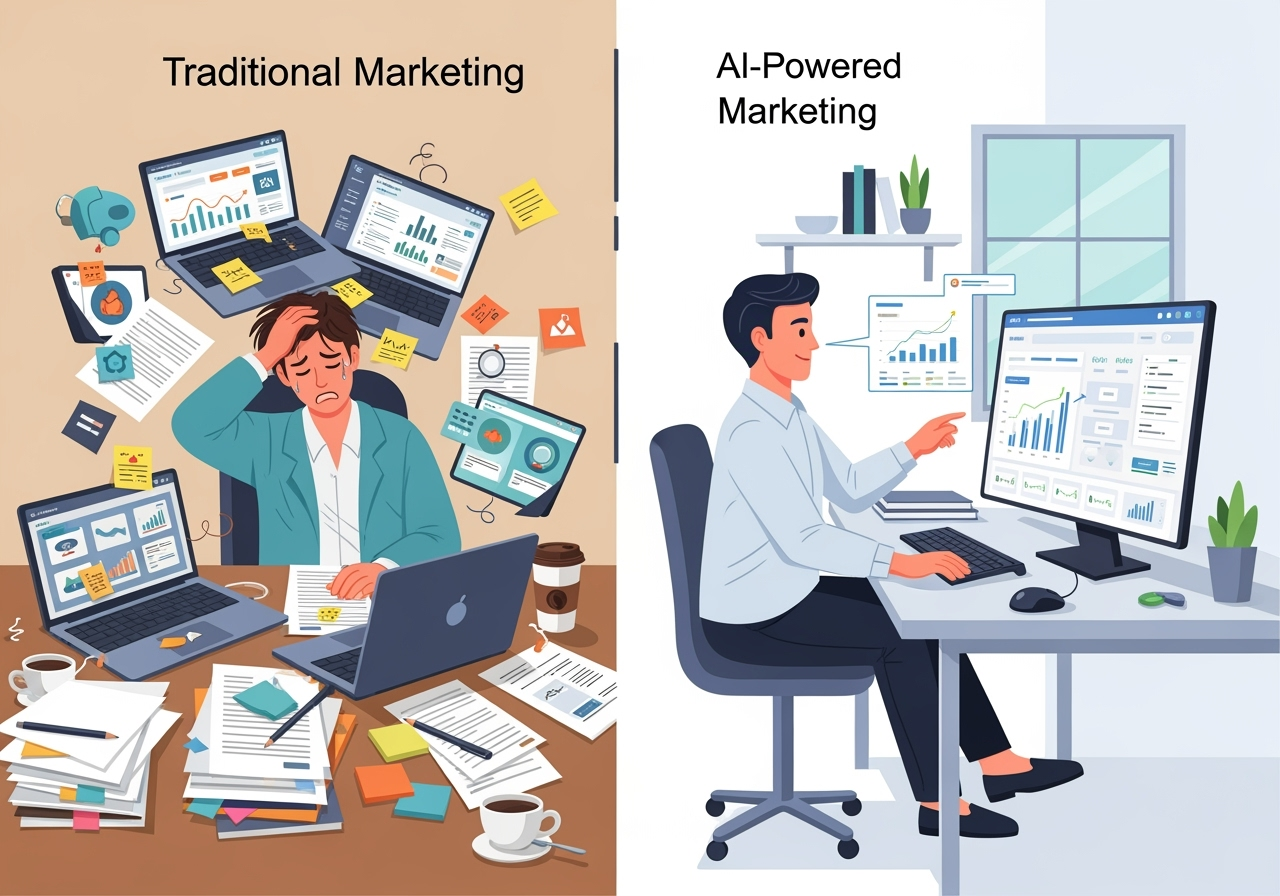
1. The “Spray and Pray” Approach
The Mistake: 68% of startups try to be everywhere at once—Facebook, Instagram, LinkedIn, TikTok, Google Ads, content marketing, influencer partnerships, and more.
The Reality: McKinsey & Company research shows that startups with focused marketing strategies (2-3 channels maximum) achieve 340% better ROI than those spreading resources across multiple platforms.
The AI Fix: Machine learning algorithms can analyze your ideal customer profile and identify the 1-2 channels where your audience actually engages, eliminating wasteful spending.
2. Ignoring Data-Driven Decision Making
The Mistake: Making marketing decisions based on gut feelings, competitor copying, or “what worked for someone else.”
The Reality: Google Analytics Intelligence data reveals that data-driven startups are 6x more likely to achieve profitability year-over-year.
The AI Fix: AI-powered analytics tools can process thousands of data points in real-time, providing actionable insights that human analysis would take weeks to uncover.
3. Inconsistent Brand Messaging
The Mistake: Different messages across different platforms, confusing value propositions, and unclear brand positioning.
The Reality: Nielsen studies show that consistent brand presentation increases revenue by up to 23%.
The AI Fix: AI content generation tools ensure brand voice consistency across all touchpoints while personalizing messages for different audience segments.
4. Neglecting Customer Journey Mapping
The Mistake: Focusing on top-of-funnel awareness without understanding the complete customer journey from discovery to purchase to retention.
The Reality: Salesforce research indicates that companies with defined customer journey maps achieve 54% greater marketing ROI.
The AI Fix: AI can track and analyze customer behavior patterns across multiple touchpoints, automatically optimizing the journey for maximum conversion.
5. Manual, Time-Consuming Processes
The Mistake: Spending 60-80% of marketing time on manual tasks like social media posting, email sending, lead qualification, and reporting.
The Reality: HubSpot data shows that marketing automation can increase qualified leads by 451% and reduce customer acquisition costs by 50%.
The AI Fix: Intelligent automation handles repetitive tasks while learning and improving performance over time.
6. Lack of Personalization at Scale
The Mistake: Sending generic messages to entire email lists or showing the same ads to different audience segments.
The Reality: Epsilon research reveals that 80% of consumers are more likely to purchase from brands that provide personalized experiences.
The AI Fix: AI enables hyper-personalization at scale, creating unique experiences for thousands of prospects simultaneously.
7. Inadequate Performance Measurement
The Mistake: Tracking vanity metrics (likes, followers, impressions) instead of business-critical KPIs (CAC, LTV, conversion rates, revenue attribution).
The Reality: Deloitte studies show that startups focusing on revenue-based metrics are 3x more likely to secure Series A funding.
The AI Fix: AI dashboards provide real-time ROI analysis and predictive modeling for future campaign performance.
How AI is Revolutionizing Startup Marketing {#ai-revolution}

The artificial intelligence revolution in marketing isn't coming—it's here. And smart startups are leveraging it to compete with established brands that have 10x their budgets.
The AI Marketing Advantage
Predictive Analytics: AI can forecast which leads are most likely to convert, allowing startups to focus resources on high-probability prospects.
Dynamic Content Optimization: Machine learning algorithms test thousands of content variations simultaneously, identifying winning combinations faster than traditional A/B testing.
Automated Customer Segmentation: AI analyzes behavioral patterns to create micro-segments, enabling precise targeting without manual list management.
Real-Time Bid Optimization: For paid advertising, AI adjusts bids in milliseconds based on conversion probability, maximizing ad spend efficiency.
Case Study: TechStart's 400% Growth
TechStart, a B2B SaaS company in Austin, was burning through $15,000/month in marketing spend with minimal results. After implementing AI-driven marketing automation:
- Customer Acquisition Cost dropped from $450 to $120
- Conversion rates increased from 2.1% to 8.7%
- Monthly recurring revenue grew 400% in 8 months
- Marketing team productivity improved by 300%
“AI didn't replace our marketing team—it made them superhuman,” says Sarah Chen, TechStart's CMO.
Real Success Stories: AI Marketing Transformations {#success-stories}
FinanceFlow: From $0 to $2M ARR in 18 Months
Challenge: Personal finance app struggling to acquire users in a crowded market.
AI Solution: Implemented predictive lead scoring and automated nurture sequences.
Results:
- User acquisition cost reduced by 65%
- App downloads increased 850%
- Customer lifetime value improved by 240%
EcoLogistics: Competing Against Industry Giants
Challenge: Green logistics startup competing against FedEx and UPS for enterprise clients.
AI Solution: AI-powered account-based marketing and personalized outreach at scale.
Results:
- Enterprise client acquisition increased 300%
- Sales cycle shortened from 9 months to 4 months
- Revenue per customer increased 180%
Your AI Marketing Implementation Framework {#implementation}
Phase 1: Foundation (Weeks 1-2)
Audit Current Performance:
- Analyze existing marketing data
- Identify biggest pain points
- Calculate current CAC and LTV
Set Up AI-Ready Infrastructure:
- Implement proper tracking systems
- Integrate marketing tools and CRM
- Establish data collection protocols
Phase 2: Quick Wins (Weeks 3-6)
Deploy Basic AI Automation:
- Email marketing automation
- Social media scheduling and optimization
- Basic lead scoring
Expected Results:
- 20-30% improvement in efficiency
- 15-25% reduction in manual work
- Initial data collection for advanced AI
Phase 3: Advanced Implementation (Weeks 7-12)
Advanced AI Features:
- Predictive analytics
- Dynamic content personalization
- Cross-channel attribution modeling
Expected Results:
- 40-60% improvement in conversion rates
- 30-50% reduction in customer acquisition costs
- Scalable, data-driven marketing operations
Phase 4: Optimization & Scale (Ongoing)
Continuous Improvement:
- Regular model training and updates
- Advanced segmentation strategies
- Predictive customer lifetime value modeling
Getting Started Today: Your AI Marketing Checklist {#getting-started}
Immediate Actions (This Week)
- [ ] Audit your current marketing stack – Identify which tools can integrate with AI
- [ ] Analyze your customer data – Ensure you have sufficient data quality for AI implementation
- [ ] Define success metrics – Focus on revenue-impacting KPIs, not vanity metrics
- [ ] Research AI marketing platforms – Consider tools like HubSpot AI, Marketo, or custom solutions
Short-Term Goals (Next 30 Days)
- [ ] Implement basic marketing automation – Start with email sequences and social media scheduling
- [ ] Set up proper analytics tracking – Ensure all customer touchpoints are measured
- [ ] Create customer journey maps – Understand your current funnel performance
- [ ] Begin A/B testing systematically – Establish baseline performance metrics
Long-Term Strategy (Next 90 Days)
- [ ] Deploy predictive analytics – Use AI to forecast customer behavior and campaign performance
- [ ] Implement dynamic personalization – Create unique experiences for different customer segments
- [ ] Optimize cross-channel attribution – Understand which marketing efforts drive actual revenue
- [ ] Scale successful campaigns – Use AI insights to expand winning strategies
The Cost of Waiting
Every day your startup operates without AI-enhanced marketing, you're falling further behind competitors who are already leveraging these technologies. The startups that survive and thrive in 2025 will be those that embrace AI not as a replacement for human creativity, but as an amplifier of human intelligence.
Consider this: If AI can improve your conversion rates by just 25% and reduce your customer acquisition costs by 30%, what would that mean for your startup's runway and growth trajectory?
Ready to Transform Your Marketing?
The choice is clear: continue struggling with outdated marketing approaches that have a 73% failure rate, or embrace AI-powered strategies that are helping startups achieve unprecedented growth.
At Intelli Brand AI, we've helped over 120 businesses implement AI-driven marketing strategies that deliver measurable results. Our approach combines traditional marketing fundamentals with cutting-edge AI automation, ensuring you get the best of both worlds.
Don't let your startup become another statistic. The AI marketing revolution is here—and it's time to be part of it.
Internal Links to Include:
- Link to your AI automation services page
- Link to your digital marketing consultation page
- Link to your case studies page
- Link to your Google Nano Banana article