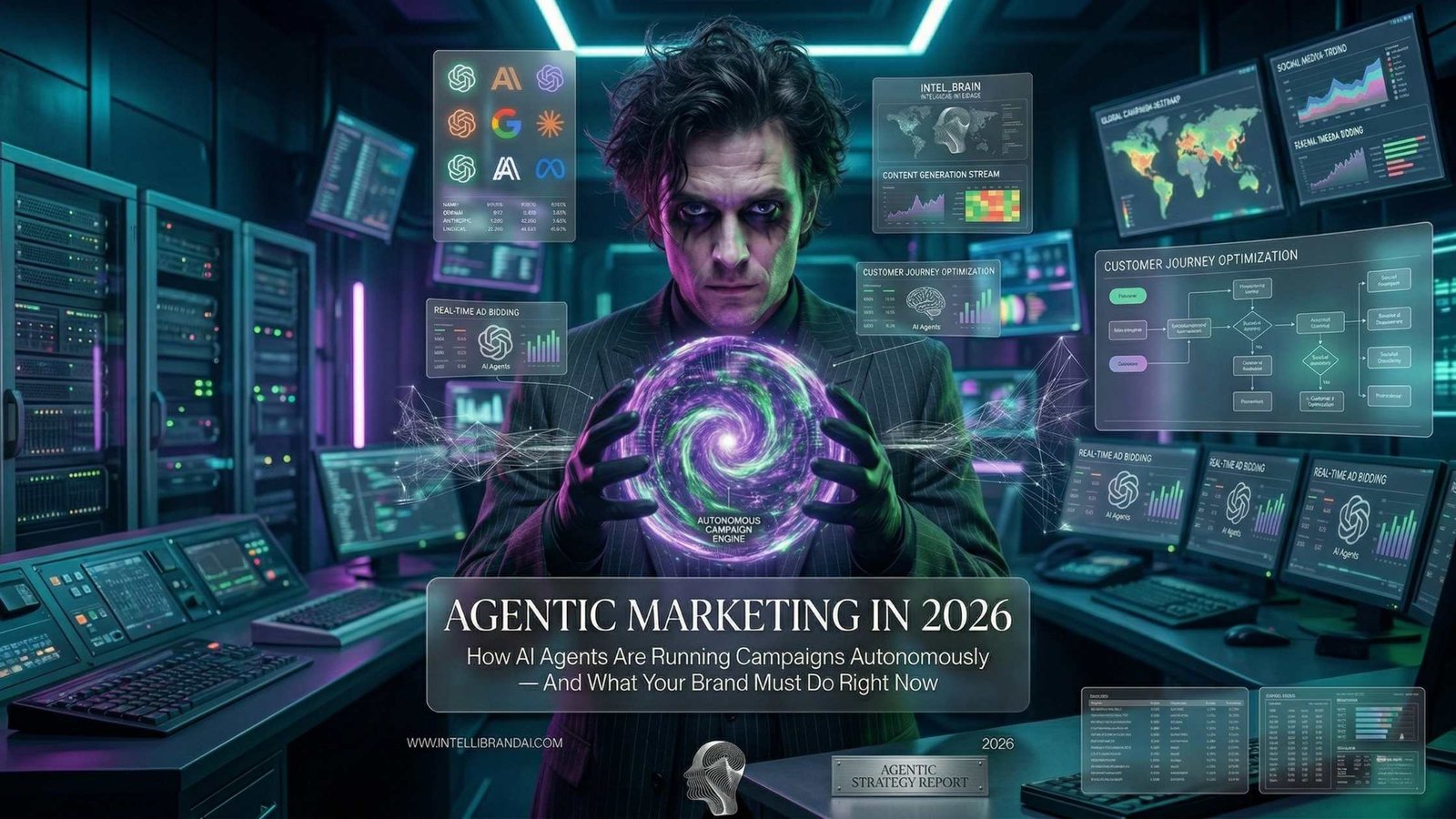
The rise of AI agents, “Share of LLM,” and Generative Engine Optimization (GEO) the three forces reshaping every brand's visibility in the next 12 months.
Picture this: a potential customer picks up their phone, opens an AI assistant, and types “What's the best digital marketing agency for a small business in Toronto?” The AI doesn't show ten blue links. It thinks for two seconds — then recommends three brands by name, with reasons. Is your brand one of them?
Welcome to the era of Agentic Marketing. In 2026, the rules of visibility, customer acquisition, and campaign management have been fundamentally rewritten — not by humans, but by autonomous AI agents. And if you haven't heard the term “Share of LLM” yet, you're already behind.
At Intelli Brand AI, we work with businesses at every stage of their digital journey, from brand strategy to AI automation. In this article, we break down everything you need to know about agentic AI in marketing — what it means, why it matters, and the exact steps your brand should take today.
What Is Agentic Marketing? (And Why It's Not Just Automation)
For the past decade, “marketing automation” meant one thing: if a customer does X, send them Y. Rules. Sequences. Pre-programmed workflows. Powerful, yes — but fundamentally passive and rigid.
Agentic AI flips this entirely. An AI agent doesn't wait for triggers. It receives a goal — say, “reduce churn by 15% in the enterprise segment” — and independently figures out how to achieve it. It identifies at-risk customers, selects the right channel, crafts the message, launches the intervention, measures results, and adjusts its approach for the next cohort. All without a human designing each step.
“In agentic marketing, the human moves to the top of the loop, not out of the loop. You define the strategy; the agent executes at a scale no human team could match.”
| Capability | Traditional Automation | AI-Powered Automation | Agentic AI Marketing |
|---|---|---|---|
| Logic | Fixed rules (if/then) | ML-optimized rules | Goal-driven reasoning |
| Adaptability | None — manual updates | Optimizes within rules | Autonomously rewrites strategy |
| Human role | Builds every workflow | Reviews recommendations | Sets goals & monitors |
| Real-time response | No | Limited | Yes — millisecond decisions |
| Complexity handled | Low | Medium | High — cross-channel, multi-segment |
| Best for | Simple email sequences | Campaign optimization | Full marketing orchestration |
The distinction matters enormously for budgeting, hiring, and platform selection. Many vendors today are selling “agentic AI” that is really just improved automation with better branding. Industry analysts estimate that fewer than 130 out of thousands of claimed AI agent vendors are building genuinely autonomous systems — so due diligence is critical.
The Numbers That Should Keep Every CMO Up at Night
$201.9B
Agentic AI spending projected in 2026 (Gartner)
Enterprise apps will embed AI agents by end of 2026 (up from <5% in 2025)
Marketers now use AI in their daily roles
Average ROI documented in agentic AI marketing deployments
Global AI marketing market size in 2026
Organizations still in “experimental phase” — the gap is widening fast
The global AI marketing market reached $47.32 billion in 2026 and is on track to hit $107.5 billion by 2028 — a 36.6% annual growth rate. More striking: companies that have actually deployed agentic systems report 50–77% reductions in technology costs and documented ROI improvements up to 2,101% from strategic consolidation alone.
“Share of LLM” — The Most Important Marketing Metric You've Never Heard Of
For the past decade, marketers obsessed over Domain Authority (DA) as a proxy for digital credibility. That era is ending. In 2026, a new and arguably more critical metric has emerged: Share of LLM (SoL).
Share of LLM measures how frequently an AI assistant — ChatGPT, Perplexity, Google Gemini, Claude, or any other large language model — recommends, cites, or mentions your brand when a user asks a relevant question. It is the AI-era equivalent of Share of Voice in traditional media. And unlike traditional SEO rankings, it operates on an entirely different logic.
Real-world example: A buyer searching for “best digital branding agency for startups” no longer gets a list of links — they get a direct answer from an AI assistant that names two or three agencies. The brands that appear in that answer have a high Share of LLM for that query. The brands that don't? Invisible — even if they rank #1 on Google's traditional results.
This shift is accelerating because AI agents are increasingly the buyers. As MarTech reported, agentic commerce means AI assistants autonomously check stock, compare options, and initiate purchases on behalf of users. If your brand isn't in the AI's consideration set, you are not in the customer's consideration set.
How to improve your Share of LLM
This is where GEO (Generative Engine Optimization) comes in. Unlike traditional SEO, which focuses on keyword density and backlinks, GEO focuses on making your content easy for AI systems to parse, trust, and cite. The core pillars are:
1
Factual accuracy & source authority
AI models heavily weight content that cites credible, verifiable data. Reference authoritative sources like Gartner, McKinsey, MIT, and peer-reviewed studies. Unsupported claims are deprioritized by LLMs.
2
Structured data & schema markup
Use FAQ schema, HowTo schema, Article schema, and Organization schema. These structured signals help AI systems understand what your content is about and extract precise answers.
3
Semantic richness & entity clarity
Write in clear, declarative sentences. Define key terms. Use your brand name, location, and service category consistently — AI models build entity graphs, and clarity improves your recognition.
4
Authoritative backlinks & citations
Be cited by and linked from high-authority domains (Forbes, HubSpot, Harvard Business Review, industry associations). LLMs learn from the web — if other trusted sources reference you, your authority in AI models rises.
5
Original perspectives & proprietary data
AI models prioritize content that adds unique insight over content that merely aggregates existing information. Case studies, original research, expert quotes, and novel frameworks dramatically increase your LLM citation rate.
How Agentic AI Is Running Marketing Right Now: 6 Real Use Cases
Agentic AI in marketing is no longer theoretical. Here are six concrete ways autonomous agents are operating today — and what this means for your team:
1. Campaign creation and real-time optimization
An agent receives a goal (e.g., “generate 200 qualified leads in Q2 at under $15 CAC”) and autonomously builds the campaign: selects channels, writes ad copy variations, sets targeting parameters, monitors performance, and reallocates budget between winning and losing variants — all without a human touching the campaign after launch.
2. The “Silent Funnel” monitoring
Today's buyers complete roughly 90% of their research journey anonymously — reading LinkedIn threads, comparing vendors in private communities, and consulting AI assistants. AI agents can now monitor these signals (within privacy-compliant parameters), detect high-intent behavior from target accounts, and trigger personalized outreach before a prospect ever fills out a form.
3. Churn prediction and autonomous intervention
Instead of waiting for a customer to go 30 days without engagement, an agent identifies behavioral risk signals weeks earlier, selects the right retention offer for that specific customer profile, delivers it through the channel where they're most active, measures the result, and updates its model for the next intervention cycle.
4. Social media and content publishing
Agents monitor trending topics in your niche, generate platform-specific content with the correct tone and format, schedule posting at each audience segment's peak engagement moment, and flag comments that require a human response — all within guardrails that you define.
5. Multi-agent collaboration for complex campaigns
The most advanced deployments use multiple specialized agents working together: a data-analysis agent feeds insights to a content-generation agent, which passes drafts to a brand-consistency agent for approval, which hands off to a scheduling-and-distribution agent. This is the marketing equivalent of a full department operating at machine speed.
6. Agent-to-agent commerce
This one sounds like science fiction but is already happening. Buyers' AI agents are reaching out directly to brands' AI agents to check product availability, negotiate terms, and place orders. If your commerce stack cannot communicate with external agents via protocols like OpenAI's ACP, you will be invisible to these automated buyers.
The Human Edge: What AI Agents Cannot Replace
None of this means human marketers are obsolete. Quite the opposite — as agents handle the structural 70% of marketing work (research, formatting, drafting, bidding, reporting), the human role becomes more valuable, not less. What only humans bring:
Creative Logic: The unique brand narrative, cultural nuance, and authentic voice that AI cannot fabricate.
Ethical Judgment: Deciding which trade-offs to make when AI optimization conflicts with brand values or customer trust.
Strategic Orchestration: Setting the goals, defining the guardrails, and monitoring for outcomes that matter — not just metrics that move.
Relationship Capital: Partnership development, community leadership, and the genuine human connections that build brand loyalty at depth.
The brands that will win in the agentic era are not those that replace their teams with AI, but those that redesign their teams around AI — empowering people to operate as strategic orchestrators rather than task executors.
Your 5-Step Agentic AI Readiness Plan for Small & Medium Businesses
You don't need a $10M MarTech budget to start. Here's a practical roadmap designed specifically for growing businesses:
1
Audit your data foundation
Agents are only as good as the data they run on. Do you have unified customer profiles? Can you access behavioral data in real time? Is your CRM clean and up to date? Fix the data foundation first — an agentic system built on poor data will underperform traditional automation.
2
Identify your highest-volume repetitive tasks
List every marketing task your team does that is structural: pulling analytics reports, scheduling social posts, following up with leads after a form fill, responding to basic customer service queries. These are your first automation candidates.
3
Deploy no-code agents for quick wins
Platforms like no-code AI automations — combined with tools like Make.com, Gumloop, or HubSpot Breeze — let you deploy your first agents without engineering resources. Start with one high-volume task and measure the time saved.
4
Build your GEO content strategy
Start optimizing your existing blog posts and web pages for AI discoverability. Add FAQ schema, cite authoritative sources, use clear entity language, and create definitive “answer” content on the questions your customers ask AI assistants most often.
5
Measure Share of LLM monthly
Use tools like Profound, Goodie AI, or manual prompting sessions to ask major AI assistants your target queries monthly. Track whether your brand name appears. This is your new Share of Voice KPI.
Frequently Asked Questions
What is Agentic Marketing?
Agentic Marketing is the use of autonomous AI agents to plan, execute, and optimize marketing campaigns without step-by-step human instruction. Unlike traditional automation, agents reason about goals, adapt in real time, and can operate across multiple channels simultaneously.
What does “Share of LLM” mean for my brand?
Share of LLM measures how often an AI assistant (ChatGPT, Perplexity, Gemini, etc.) recommends or mentions your brand when answering relevant user queries. It is the AI-era equivalent of Share of Voice. As AI assistants become primary research and purchase tools, Share of LLM is becoming the most important brand visibility metric.
What is GEO (Generative Engine Optimization)?
GEO is the practice of optimizing your content to be surfaced, cited, and recommended by AI-driven search engines like Google AI Overviews, ChatGPT Search, and Perplexity. It differs from traditional SEO by emphasizing factual accuracy, schema markup, semantic clarity, and authoritative sourcing over keyword density and backlink volume alone.
Can small businesses realistically use Agentic AI?
Yes — and the barrier to entry has fallen dramatically in 2026. No-code platforms allow small teams to deploy AI agents for social scheduling, lead follow-up, and reporting without writing a single line of code. The key is starting with a clear use case, clean data, and defined guardrails.
Is my brand visible to AI agents doing research for buyers?
If your website lacks structured data, your content doesn't cite authoritative sources, and you haven't built GEO into your content strategy, the honest answer is probably: no. The good news is that this is fixable with the right content and technical SEO approach — which is exactly what our team specializes in at Intelli Brand AI.
The Bottom Line
Agentic AI is not a future trend — it is the current operating environment. The brands that treat it as a future problem will find themselves invisible to AI-mediated buyers, outpaced by competitors with leaner agentic stacks, and struggling to understand why their traditional SEO is delivering diminishing returns.
The brands that act now — building their GEO foundations, piloting autonomous agents on high-volume tasks, and training their teams to be strategic orchestrators — will hold a compounding advantage that grows more difficult to close with every passing quarter.
The question is not whether your marketing will become agentic. The question is whether you will be the one running those agents — or whether your competitors will.
At Intelli Brand AI, we help businesses at every stage implement AI-powered automations, build content strategies optimized for the AI era, and develop the brand foundations that make you recommendable — by humans and AI alike. Explore our strategic consulting services or book a free strategy call to start the conversation.