Quick Answers: The “Is It Easy or Hard?” Cheat Sheet
Before we dive deep, here's the executive summary every business leader wants:
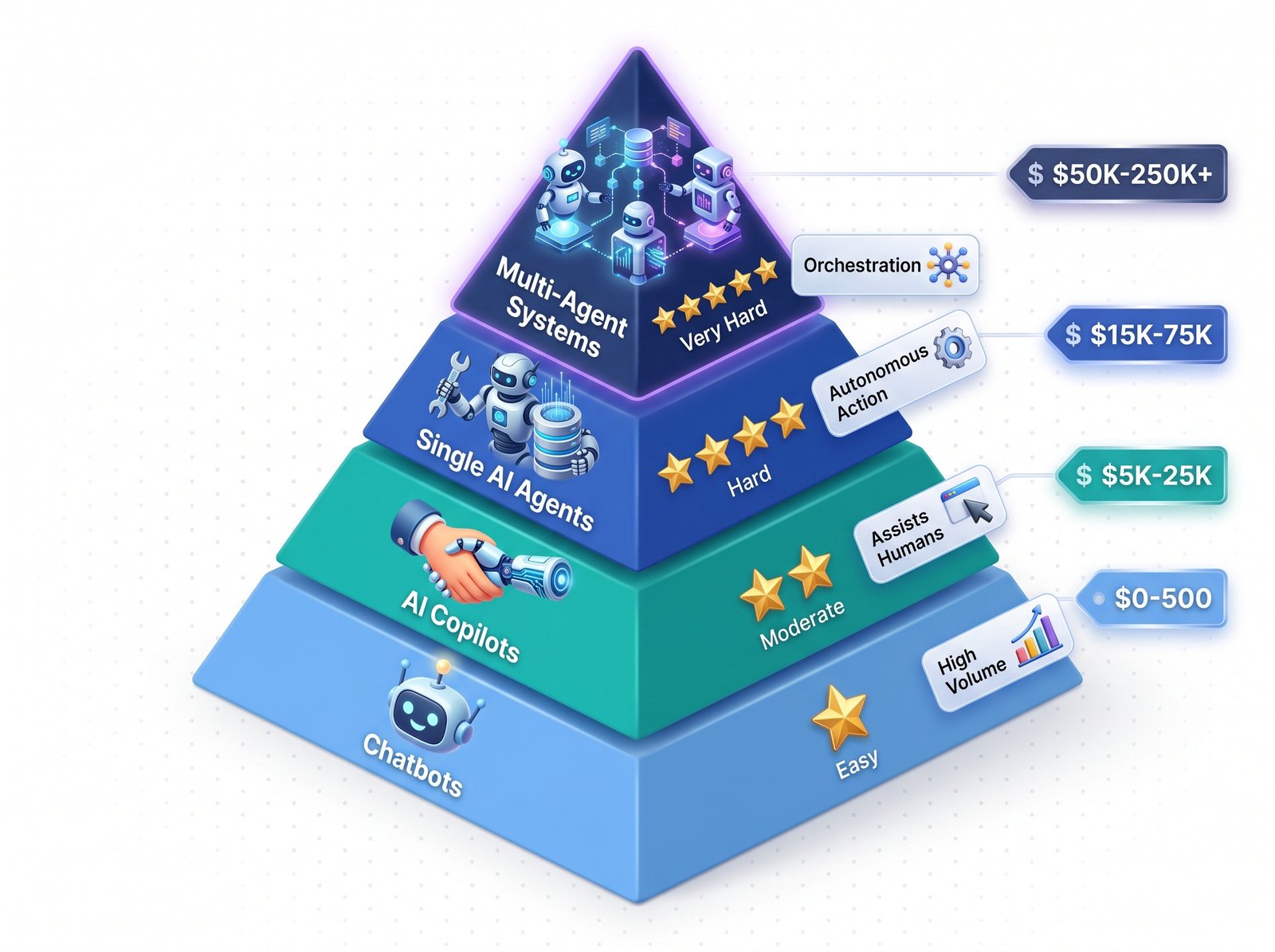
Table
| Technology | What It Does | Implementation Difficulty | Typical Cost (2026) |
|---|---|---|---|
| Basic Chatbot | Answers FAQs with scripted responses | ⭐ Easy (1-3 days) | $0–$500 (DIY) |
| LLM-Powered Chatbot | Conversational AI with knowledge base | ⭐⭐ Moderate (1-3 weeks) | $2,500–$15,000 |
| AI Copilot / Assistant | Helps humans complete tasks interactively | ⭐⭐ Moderate (2-4 weeks) | $5,000–$25,000 |
| Single AI Agent | Autonomously plans and executes multi-step workflows | ⭐⭐⭐⭐ Hard (1-3 months) | $15,000–$75,000 |
| Multi-Agent System | Coordinated AI agents working together | ⭐⭐⭐⭐⭐ Very Hard (3-6 months) | $50,000–$250,000+ |
1. Why AI Terminology Matters in 2026
If you're evaluating AI for your business in 2026, you're not alone. 91% of businesses with 50+ employees now use AI chatbots in some part of the customer journey, and 51% of enterprises already have AI agents running in production
But here's the problem: most articles conflate “chatbot” with “AI agent,” “LLM” with “AI,” and “copilot” with “automation.” This confusion costs companies millions. According to Gartner, more than 40% of agentic AI projects will be canceled by the end of 2027 due to misaligned expectations, cost overruns, and weak governance
Understanding the terminology isn't academic — it's the difference between a $15,000 tool that delivers ROI in three months and a $100,000 science experiment that never launches
.
This guide breaks down every critical AI term, explains exactly what each technology does, and answers the only question that really matters: Is this easy or hard to implement for my business?
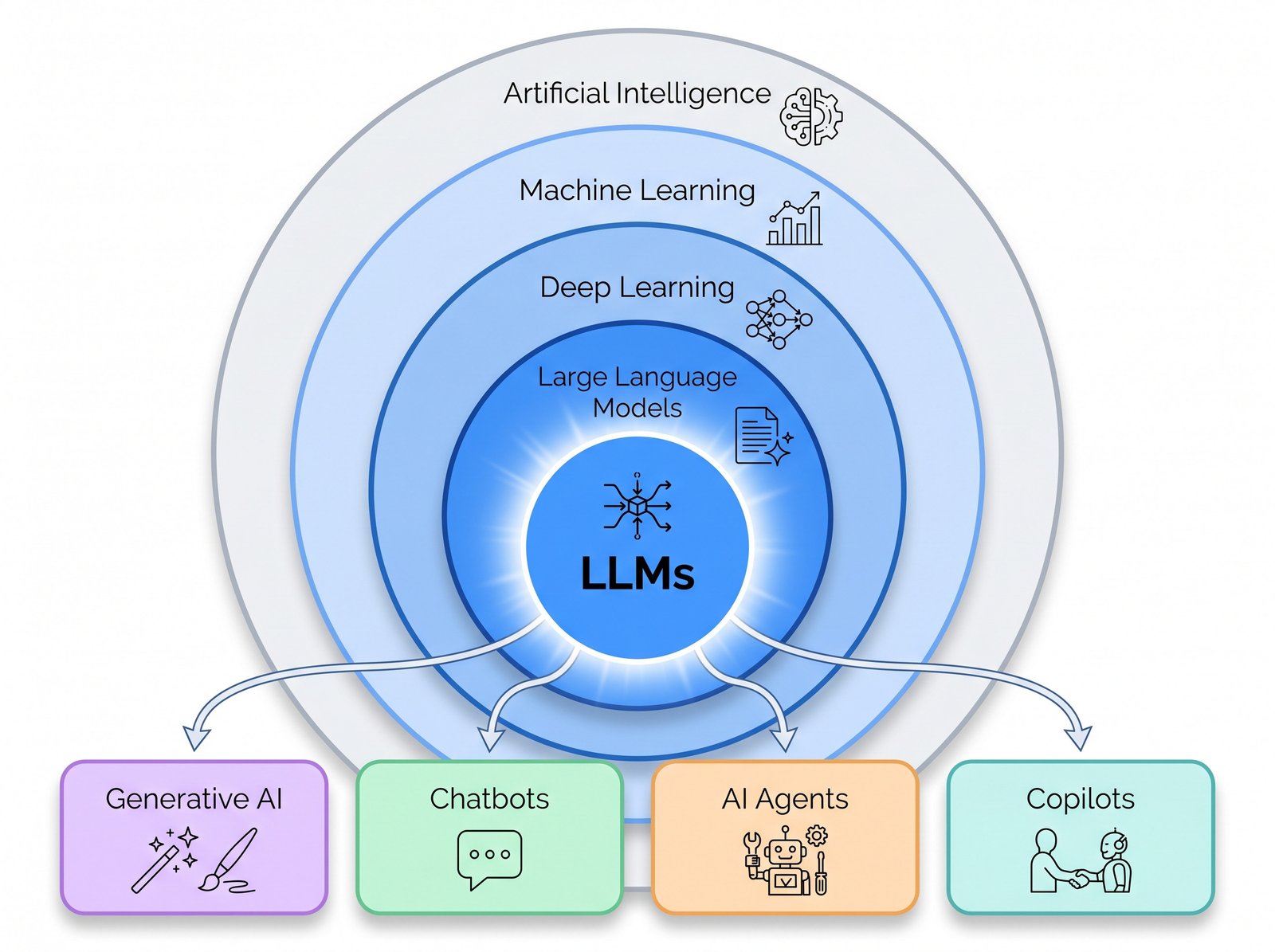
2. The AI Hierarchy: How Everything Connects
Artificial Intelligence (AI)
Definition: The broad field of computer systems performing tasks that typically require human intelligence — reasoning, learning, problem-solving, perception, and language understanding.
What it's for: AI is the umbrella. Everything below falls under it.
Easy or Hard? ⭐ Easy to understand. Hard to build from scratch.
Most businesses don't “build AI.” They use AI-powered tools.
Machine Learning (ML)
Definition: A subset of AI where systems learn patterns from data without being explicitly programmed for every scenario.
What it's for: Fraud detection, recommendation engines, predictive analytics, spam filtering.
Easy or Hard? ⭐⭐ Moderate.
Requires clean data and statistical expertise. Most businesses use ML through platforms (e.g., Salesforce Einstein, Google Analytics) rather than building custom models.
Artificial Intelligence (AI)
Definition: The broad field of computer systems performing tasks that typically require human intelligence — reasoning, learning, problem-solving, perception, and language understanding.
What it's for: AI is the umbrella. Everything below falls under it.
Easy or Hard? ⭐ Easy to understand. Hard to build from scratch.
Most businesses don't “build AI.” They use AI-powered tools.
Machine Learning (ML)
Definition: A subset of AI where systems learn patterns from data without being explicitly programmed for every scenario.
What it's for: Fraud detection, recommendation engines, predictive analytics, spam filtering.
Easy or Hard? ⭐⭐ Moderate.
Requires clean data and statistical expertise. Most businesses use ML through platforms (e.g., Salesforce Einstein, Google Analytics) rather than building custom models.
Deep Learning
Definition: A subset of ML using neural networks with many layers (hence “deep”) to model complex patterns. Powers image recognition, voice synthesis, and language models.
What it's for: Facial recognition, medical imaging, autonomous driving, and — critically — the foundation of modern LLMs.
Easy or Hard? ⭐⭐⭐⭐ Hard.
Requires massive compute (GPUs), specialized talent, and millions in infrastructure. Not a typical business project.
3. The Engine: Large Language Models (LLMs)
What Is an LLM?
A Large Language Model is a deep learning system trained on vast amounts of text to understand, generate, and reason with human language. Think of it as the “brain” behind ChatGPT, Claude, Gemini, and Copilot.
Key LLMs in 2026:
- GPT-4.1 / GPT-5 (OpenAI)
- Claude 4.6 Sonnet/Opus (Anthropic)
- Gemini 2.5 Pro (Google DeepMind)
- Llama 3.1/4 (Meta — open source)
What it's for: Writing, coding, analysis, translation, summarization, and — when connected to tools — autonomous action.
Easy or Hard? ⭐⭐ Moderate to use. Very hard to build.
You don't build an LLM. You call one via API. The complexity lies in prompt engineering, context management, and integration.
Critical LLM Concepts You Must Know
Tokens & Context Windows
- Token: The basic unit of text an LLM processes (roughly 0.75 words). You pay per token.
- Context Window: How much text the model can “remember” at once. In 2026, leading models handle 128K–2M tokens.
Cost Reality (2026):
API costs have dropped 50% year-over-year
. A customer service agent handling 1,000 daily conversations costs $800–$1,500/month in API fees using GPT-4o-level models
.
Hallucination
When an LLM generates confident but false information. This is the #1 risk in production AI. Mitigation requires RAG, guardrails, and human-in-the-loop workflows.
Prompt Engineering
The craft of writing instructions that make an LLM produce accurate, useful outputs. In 2026, this has evolved into prompt orchestration — chaining multiple prompts for complex tasks.
4. Generative AI (GenAI): The Creative Layer
Definition: AI systems that generate new content — text, images, video, audio, code — rather than just analyzing existing data.
What it's for:
- Marketing copy and blog posts
- Product images and video ads
- Code generation and debugging
- Personalized email sequences
- Synthetic training data
Easy or Hard? ⭐⭐ Moderate.
Tools like ChatGPT, Midjourney, and Canva's AI make GenAI accessible. Enterprise deployment (brand consistency, compliance, quality control) is harder and requires governance frameworks.
Market Context: The generative AI market is projected to reach $50.31 billion by 2030 at a 45.8% CAGR
.
5. The Big Four: Chat vs. Chatbot vs. Agent vs. Copilot
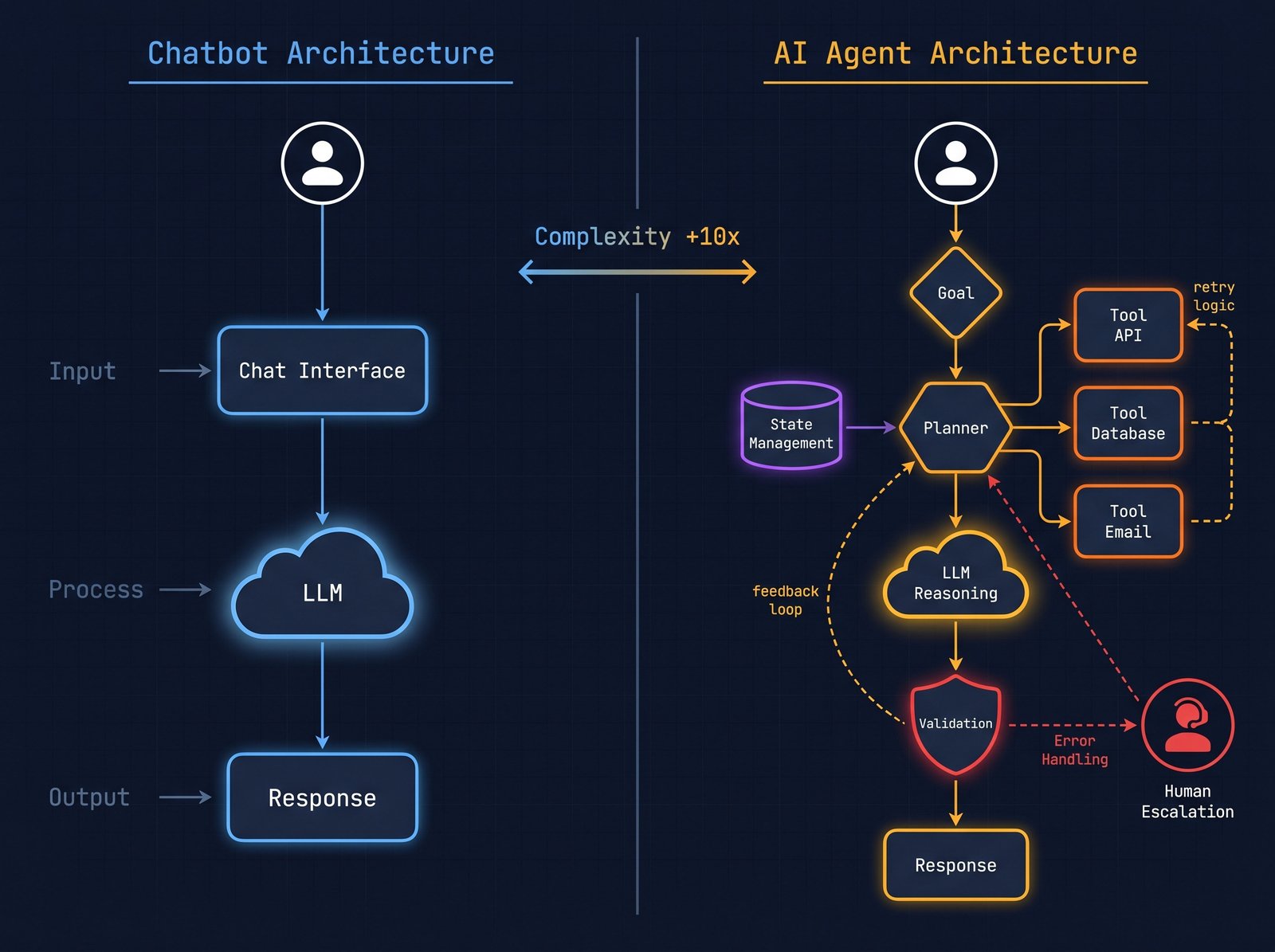
This is the section your procurement team, CTO, and CEO all need to read. These four terms are constantly confused — and choosing the wrong one is expensive.
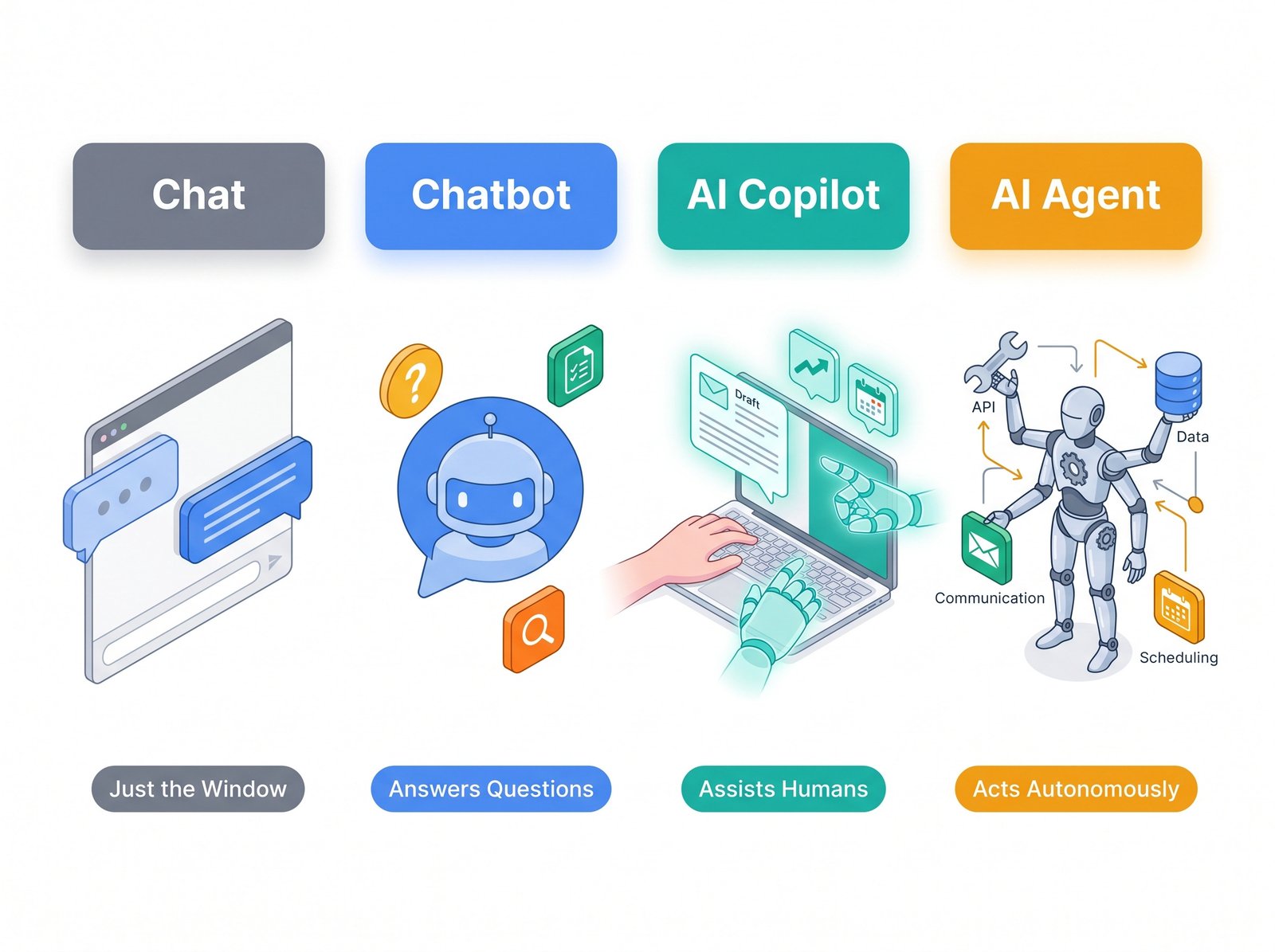
5.1 Chat / Chat Interface
Definition: A conversational user interface — the window where humans and AI exchange messages. Not the AI itself, just the medium.
What it's for: Customer support portals, Slack integrations, website widgets, mobile apps.
Example: The message thread you see in ChatGPT, WhatsApp, or your bank's app.
Easy or Hard? ⭐ Easy.
A chat interface is just UI/UX design. The complexity lives in what's behind it.
5.2 Chatbot
Definition: An AI application that conducts conversations via text or voice. In 2026, there are two distinct species:
Rule-Based Chatbots (Legacy)
- Follow scripted decision trees: “If user says X, respond Y.”
- Handle 20–40% of autonomous interactions max .
- Cheap, fast, brittle.
LLM-Powered Chatbots (Modern)
- Use large language models + RAG to answer from your knowledge base.
- Handle 40–60% of interactions with embedded business logic .
- Natural, flexible, but can hallucinate.
What chatbots are for:
- FAQ deflection
- Order tracking
- Appointment booking
- Lead qualification
- First-line customer support
Easy or Hard? ⭐⭐ Moderate.
No-code platforms (Chatbase, Dante AI, Botpress) let you launch in hours. Production-grade chatbots with RAG, guardrails, and CRM integration take 1–3 weeks.
Cost: $15,000–$25,000 for simple FAQ bots; $40,000–$60,000 for workflow-integrated versions
.
Stat to Know: AI chatbot interactions cost $0.50–$0.70 versus $6.00–$15.00 for human agents. Gartner estimates conversational AI will save $80 billion in contact-center labor costs by 2026
.
5.3 AI Copilot / AI Assistant
Definition: An AI that assists a human worker in real-time, embedded within a specific tool or workflow. The human remains in control; the AI accelerates execution.
What copilots are for:
- GitHub Copilot: Suggests code as you type
- Microsoft 365 Copilot: Drafts emails, summarizes meetings, analyzes Excel data
- Salesforce Einstein: Recommends next actions in CRM
- Adobe Firefly: Assists image creation in Creative Cloud
Key Trait: The AI augments the human. It doesn't act alone.
Easy or Hard? ⭐⭐ Moderate.
Most copilots are SaaS add-ons you license ($20–$50/user/month). Custom copilots built on your proprietary data require RAG, API integrations, and UX design — 2–4 weeks of development.
5.4 AI Agent / Agentic AI
Definition: An autonomous system that receives a high-level goal, plans a multi-step sequence of actions, uses tools/APIs to execute, and adapts based on feedback — all without human intervention at each step.
This is the critical distinction:
- Chatbot: Responds to your prompt. One turn at a time.
- Agent: Takes a goal, breaks it into steps, executes across systems, and reports back.
What agents are for:
- Customer Service: “Process this refund” → verifies purchase, checks policy, issues refund, updates ERP, notifies customer.
- Sales: “Qualify this lead and schedule a demo” → researches company, scores fit, drafts email, checks calendar, sends invite.
- IT Operations: “Investigate this server alert” → checks logs, identifies root cause, restarts service, opens ticket.
- Finance: “Reconcile this month's invoices” → pulls data, matches POs, flags discrepancies, generates report.
Easy or Hard? ⭐⭐⭐⭐ Hard. Very hard for multi-agent.
Why it's hard:
- Reasoning loops: The agent must plan, execute, check results, and retry if failed.
- Tool use: Every API integration adds failure surface area (auth tokens, rate limits, schema changes) .
- Guardrails: Agents can make expensive mistakes. You need confidence scoring, human-in-the-loop escalation, and audit trails.
- Observability: Unlike chatbots, agents run asynchronously. You need structured logging, alerts, and circuit breakers .
- Governance: Only 21% of companies have a mature governance model for agents .
Cost:
- Simple agent: $15,000–$25,000
- Workflow automation agent: $40,000–$75,000
- Enterprise multi-agent system: $50,000–$250,000+
- Monthly operations: $500–$10,000/month (APIs, hosting, monitoring)
Stat to Know: True agentic platforms routinely hit 70–85% automated resolution rates because they connect directly to backend systems and execute real actions — versus 20–40% for basic chatbots
.
6. The Architecture Comparison: Chatbot vs. Agent Side-by-Side
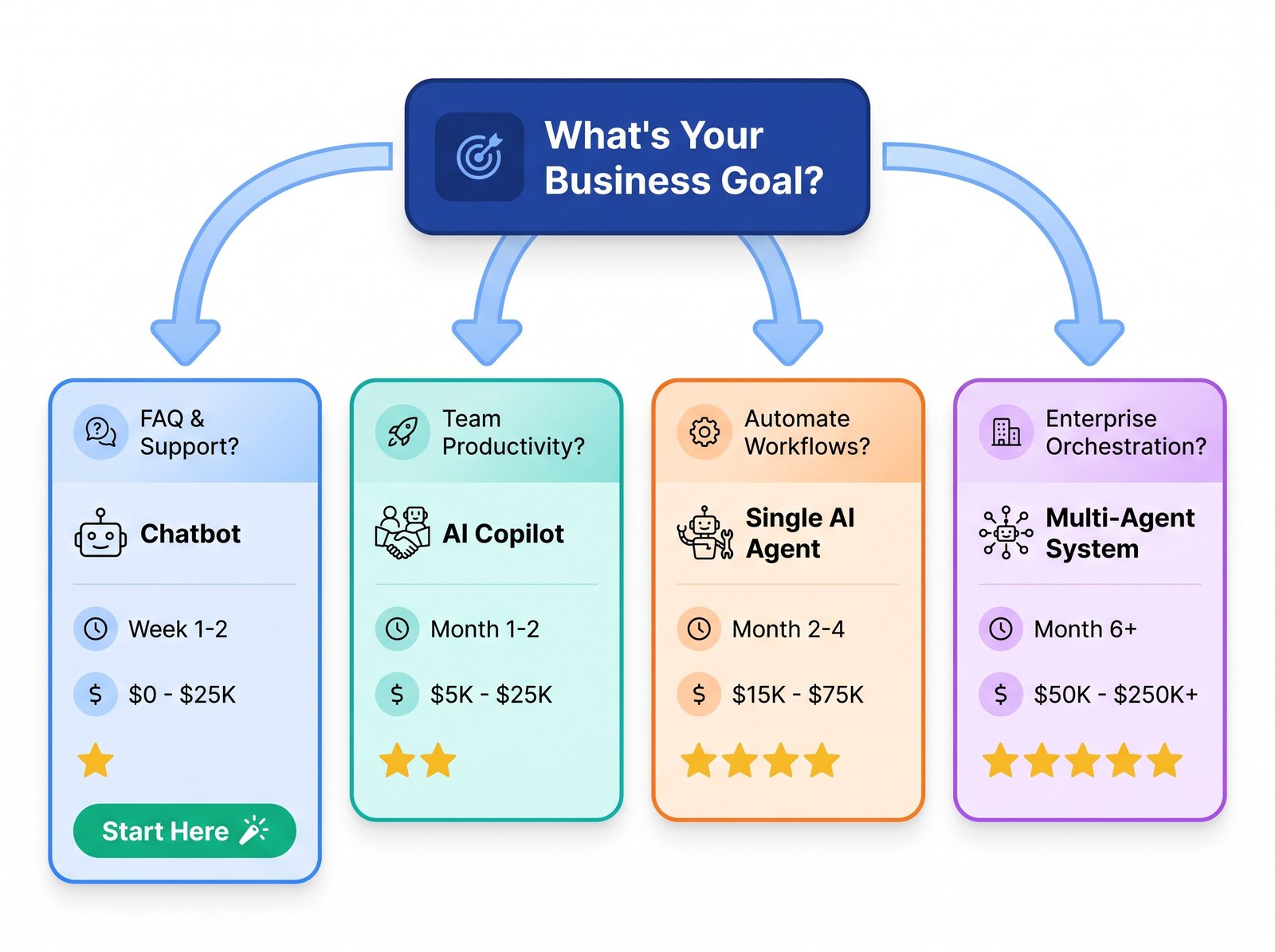
Table
7. RAG, Fine-Tuning, and MCP: The Power Tools
RAG (Retrieval-Augmented Generation)
Definition: A technique where the LLM retrieves relevant documents from a knowledge base before generating a response — grounding answers in your actual data rather than training data.
What it's for: Eliminating hallucinations in chatbots and agents. Essential for customer support, legal, medical, and financial applications.
Easy or Hard? ⭐⭐⭐ Hard.
Requires vector databases (Pinecone, Weaviate, pgvector), chunking strategies, embedding models, and relevance tuning. Most failed RAG projects suffer from poor document chunking or weak retrieval algorithms.
Fine-Tuning
Definition: Further training an existing LLM on your proprietary dataset to specialize its behavior, tone, or domain knowledge.
What it's for: Brand voice consistency, medical terminology, legal compliance, rare languages.
Easy or Hard? ⭐⭐⭐⭐ Hard.
Requires hundreds to thousands of high-quality examples, GPU compute, and ML expertise. In 2026, most businesses get better ROI from RAG + prompt engineering than fine-tuning.
MCP (Model Context Protocol)
Definition: An open standard (popularized by Anthropic) that standardizes how AI models connect to external data sources and tools — like a “USB-C port for AI.”
What it's for: Simplifying agent integrations. Instead of custom API connectors for every tool, MCP provides a universal interface.
Easy or Hard? ⭐⭐⭐ Hard (emerging).
Still early in 2026. Powerful for teams building multi-tool agents, but ecosystem maturity is 12–18 months away.
8. Multi-Agent Systems: The Final Boss
Definition: Coordinating multiple specialized AI agents that collaborate on complex tasks — like a digital team where one agent researches, another drafts, a third fact-checks, and a fourth publishes.
What it's for:
- Enterprise workflow automation
- Supply chain optimization
- Financial auditing
- Content operations at scale
- Software development (coding agents + testing agents + review agents)
Easy or Hard? ⭐⭐⭐⭐⭐ Very Hard.
Why most fail:
- Orchestration complexity: Agents must negotiate, delegate, and resolve conflicts.
- Cost explosion: 3–5x the compute of single agents.
- Debugging nightmare: When something fails, which agent caused it?
- Governance gaps: 50% of AI agents currently operate in isolated silos rather than coordinated systems .
Cost: $50,000–$250,000+ to build; $1,000–$10,000/month to operate
9. Implementation Roadmap: What Should You Build First?
Stage 1: Start with a Chatbot (Week 1–2)
If: You get repetitive questions, need 24/7 availability, and want to reduce support costs.
Tools: Chatbase, Dante AI, Botpress, Intercom Fin, Zendesk AI.
ROI: 30% cost reduction on support; $0.50 per interaction vs. $6.00 human cost
Stage 2: Upgrade to an LLM Copilot (Month 1–2)
If: Your team spends hours on drafting, data entry, or analysis.
Tools: Microsoft 365 Copilot, GitHub Copilot, custom RAG copilots.
ROI: 20–40% productivity gain in targeted workflows.
Stage 3: Deploy a Single AI Agent (Month 2–4)
If: You have a specific, high-volume workflow that follows clear rules but requires multiple system touches.
Example: “Process return requests” or “Qualify and route sales leads.”
Prerequisites: Clean APIs, documented workflows, human escalation paths, and $15K–$75K budget
Stage 4: Multi-Agent Orchestration (Month 6+)
If: You're a mid-market or enterprise company with mature data infrastructure and dedicated AI engineering.
Warning: Only 11% of organizations have agents in true production despite 66% experimenting
. Don't skip stages.
10. GEO & SEO: How This Content Is Optimized for AI Search Engines
In 2026, search isn't just Google anymore. Perplexity, ChatGPT Search, Gemini, and Bing Copilot are primary research tools for B2B buyers. This section explains how we optimized this article for Generative Engine Optimization (GEO) — and how you can apply these techniques to your own content.
GEO Techniques Used in This Article
Table
| Technique | Why It Matters |
|---|---|
| Cited Statistics | Every claim includes a source and date. AI engines prioritize verifiable facts. |
| Clear H2/H3 Structure | Enables AI summarization and “AI Overview” extraction. |
| FAQ Schema Format | Questions are phrased naturally (“What is…?” “How much…?”) for voice and AI search. |
| Comparison Tables | AI engines extract structured data faster than paragraphs. |
| Difficulty Ratings | Visual scales (⭐) help AI categorize content by user intent. |
| Cost Transparency | Real numbers with ranges satisfy B2B procurement research queries. |
SEO Checklist for Your WordPress Post
- ✅ Title Tag: Under 60 characters, includes year and primary keyword.
- ✅ Meta Description: Under 160 characters, includes value proposition and secondary keywords.
- ✅ URL Slug: Short, keyword-rich, no stop words.
- ✅ Internal Links: Link to your services page using anchor text “AI implementation services” or “enterprise AI consulting.”
- ✅ Image Alt Text: Descriptive, keyword-inclusive (see image markers above).
- ✅ Schema Markup: Add
FAQPageschema andArticleschema via RankMath or Yoast. - ✅ Table of Contents: Use a sticky TOC plugin for long-form content.
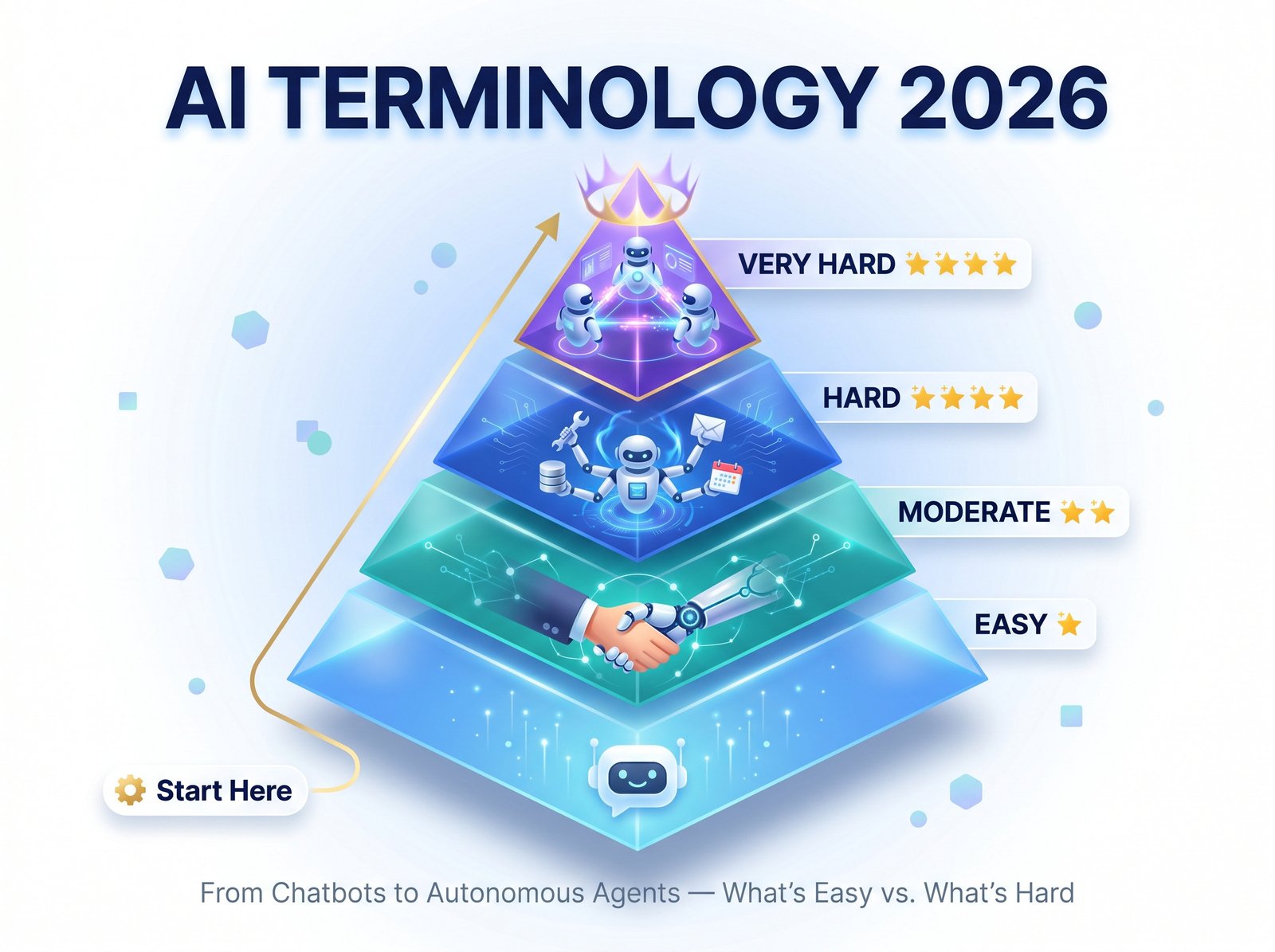
- ✅ Social Sharing: Open Graph image showing the difficulty pyramid.
11. Frequently Asked Questions (FAQ Schema Ready)
What is the difference between a chatbot and an AI agent?
A chatbot responds to individual prompts in a conversation. An AI agent receives a high-level goal, autonomously plans multiple steps, executes actions across systems (APIs, databases), and adapts if something fails. Chatbots talk. Agents do.
Is it easy to implement an AI chatbot?
Yes. No-code platforms let you launch a basic chatbot in hours. A production-grade LLM chatbot with your knowledge base takes 1–3 weeks. Costs range from $0 (DIY) to $25,000 for custom builds
Is it easy to implement an AI agent?
No. Single agents require multi-step reasoning, tool integrations, guardrails, and observability. Budget $15,000–$75,000 and 1–3 months. Multi-agent systems are enterprise-grade projects costing $50,000–$250,000+
What is RAG and do I need it?
RAG (Retrieval-Augmented Generation) grounds LLM responses in your actual documents, eliminating hallucinations. You need it for any customer-facing or high-stakes AI application.
How much do AI agents cost to run monthly?
API costs for a 1,000-conversation/day agent run $800–$1,500/month using GPT-4o-level models. Hosting adds $100–$2,000/month. Maintenance requires 10–20 hours monthly or a $2,000–$5,000 managed service retainer
What percentage of AI agent projects fail?
Gartner predicts 40%+ of agentic AI projects will be canceled by end of 2027. Primary causes: security/compliance concerns (52%), technical scaling (51%), and skilled staff shortages (44%)
What is an AI copilot vs. an AI agent?
A copilot assists a human in real-time within a specific tool (e.g., drafting an email in Outlook). An agent works autonomously toward a goal across multiple tools without human intervention at each step.
What is the ROI of AI customer service?
Companies report an average $3.50 returned for every $1 invested in AI customer service, with leaders hitting 8x ROI. First-year ROI averages 41%, compounding to 124%+ by year three
12. Conclusion: Start Smart, Scale Fast
The AI landscape in 2026 is powerful but unforgiving. The businesses winning with AI aren't necessarily the ones with the biggest budgets — they're the ones that match the right technology to the right problem.
Your playbook:
- Start with chatbots for FAQ deflection and cost savings.
- Add copilots to accelerate your team's productivity.
- Build single agents only when you have clear, high-value workflows with clean APIs.
- Attempt multi-agent systems only after you've mastered stages 1–3 and have governance in place.
The cost of waiting is rising. 91% of mid-size companies already use AI chatbots, and 51% of enterprises have agents in production
. The question isn't whether to adopt AI — it's whether you'll adopt it correctly.
References
- McKinsey & Company — State of AI 2025: https://www.mckinsey.com/capabilities/quantumblack/our-insights/the-state-of-ai
- Gartner — Predicts 2026: AI Agents: https://www.gartner.com/en/newsroom/press-releases
- Salesforce — Agentforce Performance Data: https://www.salesforce.com/news/press-releases/
- Deloitte — State of AI 2026: https://www2.deloitte.com/us/en/insights/focus/cognitive-technologies/state-of-ai-and-intelligent-automation-report.html
- PwC — AI Agent Survey 2026: https://www.pwc.com/us/en/tech-effect/ai-analytics/ai-business-predictions.html
- Anthropic — Model Context Protocol (MCP): https://www.anthropic.com/news/model-context-protocol
- OpenAI — API Pricing Documentation: https://openai.com/api/pricing/
- LangChain — State of AI Agents Report 2026: https://blog.langchain.dev/
- Dynatrace — AI Agent Pilot Survey 2026: https://www.dynatrace.com/news/blog/
- Prologica AI — AI Agent Costs 2026: https://www.prologica.ai/blog/ai-agent-costs-what-businesses-pay-in-2026
- Agix Technologies — AI Agency Pricing Guide 2026: https://agixtech.com/insights/how-much-does-it-cost-to-hire-an-ai-agency-in-2026-the-ultimate-pricing-guide/
- BMD Patrick Hughes — AI Agent Cost Breakdown 2026: https://bmdpat.com/blog/ai-agent-cost-pricing-2026
- Ringly.io — 45 AI Agent Statistics 2026: https://www.ringly.io/blog/ai-agent-statistics-2026
- Notch CX — Customer Service AI Metrics 2026: https://www.notch.cx/post/customer-service-ai-metrics
- AI Automation Global — Why 40% of AI Agent Projects Fail: https://aiautomationglobal.com/blog/ai-agent-pilot-purgatory-40-percent-fail-2026
- Dante AI — AI Chatbot Statistics 2026: https://www.dante-ai.com/news/ai-chatbot-statistics-2026-why-75-of-customers-prefer-ai-chatbots
- Chatbot.com — Key Chatbot Statistics 2026: https://www.chatbot.com/blog/chatbot-statistics/