The search landscape has transformed dramatically. In 2026, AI search traffic grew 527% year-over-year, and Google AI Overviews now appear in over 25% of all Google searches (Source: Financial Content Markets). Even more striking: 66% of consumers expect AI to fully replace traditional search within five years (Destination CRM).
Welcome to the era of Generative Engine Optimization (GEO)—the evolution of SEO designed specifically for AI-powered search engines like ChatGPT, Perplexity AI, Google Gemini, and Claude.
If your brand strategy still relies solely on traditional SEO, you're already falling behind. This comprehensive guide will show you exactly how to optimize your content for generative AI engines and secure your brand's visibility in the AI-first search landscape.
What Is Generative Engine Optimization (GEO)?
Generative Engine Optimization (GEO) is the practice of optimizing your content to be cited, referenced, and recommended by AI-powered search engines and large language models (LLMs). Unlike traditional SEO, which focuses on ranking in search engine results pages (SERPs), GEO ensures your content appears in AI-generated answers, summaries, and recommendations.
The Critical Difference: SEO vs. GEO
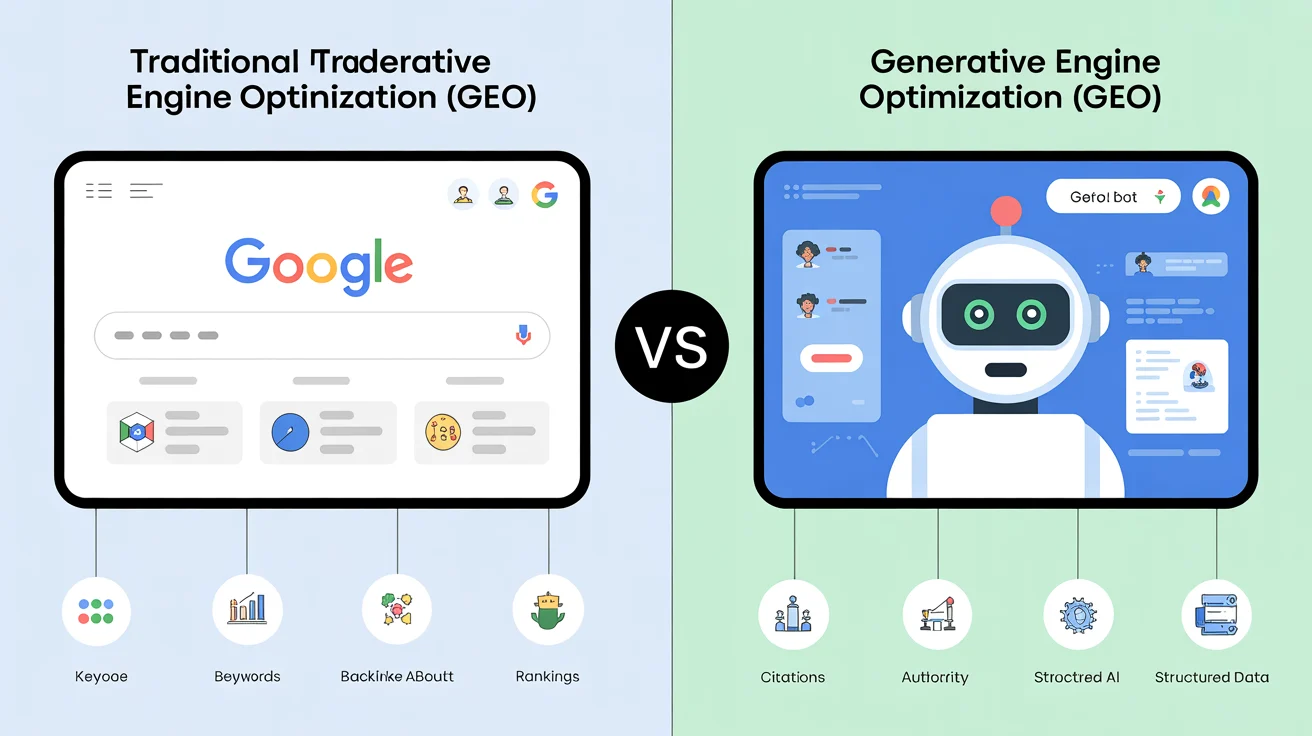
Traditional SEO vs. Generative Engine Optimization: Understanding the paradigm shift
| Traditional SEO | Generative Engine Optimization (GEO) |
|---|---|
| Optimizes for search result rankings | Optimizes for AI citations and references |
| Focus on keywords and backlinks | Focus on authority, clarity, and structured data |
| Success = Page 1 ranking | Success = Being cited by AI models |
| Metrics: CTR, bounce rate, dwell time | Metrics: Citation frequency, answer inclusion, brand mentions |
| Content designed for human readers | Content designed for both AI parsing and human readers |
| Keyword density matters | Semantic richness and factual depth matter |
According to Avintiv Media, AI models prioritize identity, structure, and clarity over traditional keyword density. This fundamental shift requires a complete rethinking of content strategy.
Why GEO Matters for Your Brand in 2026
1. Zero-Click Search Is Dominating
The rise of AI assistants means users increasingly get complete answers without clicking through to websites. Platforms like ChatGPT, Perplexity, Claude, and Google's AI Overviews provide synthesized answers that eliminate the need for traditional website visits (WordStream).
The Impact:
- Reduced organic traffic to traditional websites
- AI engines becoming the primary customer interface
- Brand visibility now depends on AI citations, not just rankings
2. Consumer Behavior Has Shifted Permanently
Research from eMarketer reveals that 133 million people in the US will use generative AI in 2026—representing 39.2% of the population. These users expect:
- Instant, conversational answers
- Synthesized information from multiple sources
- Contextual recommendations based on their specific needs
If your brand isn't optimized for these AI platforms, you're invisible to nearly 40% of the US market.
3. AI Search Engines Are the New Gatekeepers
Just as Google became the dominant gatekeeper for web traffic in the 2000s, AI engines are now controlling information discovery. According to Forbes, marketers are shifting from traditional campaigns to AI-powered systems because AI-native decision-making is becoming the foundation of modern marketing.
The 7 Core Principles of Generative Engine Optimization

Generative Engine Optimization (GEO): The New SEO Strategy for 202
Modern marketers must master both traditional SEO and emerging GEO strategies
1. Authority and Expertise (E-E-A-T for AI)
AI models heavily weight authoritative sources when generating responses. According to Qualtrics, brands must demonstrate clear expertise, authority, and trustworthiness.
Action Steps:
- Establish clear author credentials and expertise
- Include verifiable data and original research
- Cite authoritative sources and studies
- Build first-party data assets that AI can't replicate elsewhere
- Publish thought leadership from named experts
Why It Works: AI systems are designed to reduce misinformation by prioritizing content from recognized authorities. As Deloitte Digital notes, first-party data and authentic expertise are becoming “economic assets” in an AI-driven world.
2. Structured Data and Schema Markup
Structured data helps AI models understand and extract information from your content with precision. Moon Valley News confirms that JSON-LD schema markup is now mandatory in 2026 for AI crawler comprehension.
Essential Schema Types:
- Organization schema
- Article schema
- FAQ schema
- How-To schema
- Product schema
- Review schema
- BreadcrumbList schema
Implementation Example:
jsonCopy{"@context":"https://schema.org","@type":"Article","headline":"Generative Engine Optimization (GEO): The Future of SEO in 2026","author":{"@type":"Organization","name":"IntelliBrand AI"},"publisher":{"@type":"Organization","name":"IntelliBrand AI","logo":{"@type":"ImageObject","url":"https://play-lh.googleusercontent.com/61bhPwe4pUeb_RKx2OV7qkEWUr0cedpcsh1eQ8yZ9N-WsFvHD5POmb-JKy90GMYIqg=w240-h480-rw"}},"datePublished":"2026-04-06","description":"Comprehensive guide to Generative Engine Optimization (GEO) strategies for 2026"}
3. Clarity and Extractability
AI models favor content that is easy to parse and extract. Research from ALM Corp shows that definition-led sentence structures significantly improve AI citation rates.
Optimization Techniques:
- Use clear, definitive opening sentences
- Structure content with descriptive headings
- Break complex ideas into digestible sections
- Include bulleted lists and tables for key information
- Use the inverted pyramid style: most important information first
Example of High-Extractability Writing:
❌ Poor: “There are various approaches that marketers might consider when thinking about how to potentially optimize their content in ways that could help with AI visibility.”
✅ Excellent: “Generative Engine Optimization (GEO) is the practice of optimizing content to be cited by AI-powered search engines. The five core strategies include: structured data implementation, authority building, semantic richness, clear formatting, and factual depth.”
4. Semantic Richness and Context
AI models understand context and relationships, not just keywords. According to Gartner's Future of Marketing, semantic understanding is fundamental to how AI processes and recommends content.
Strategies:
- Use natural language and conversational tone
- Include related concepts and terminology
- Answer follow-up questions within content
- Provide comprehensive coverage of topics
- Use entities and named references consistently
5. Multi-Modal Content
LinkedIn research shows that generative engines prioritize multi-modal content that reduces uncertainty. This includes:
- Video explanations and demonstrations
- Annotated images and diagrams
- Audio content and podcasts
- Interactive elements
- Infographics and data visualizations
Key Insight: Content that provides clear demonstrations through various formats gains significantly higher visibility in AI-generated responses.
6. Factual Depth and Verification
AI systems cross-reference information across sources to verify accuracy. NoGood's AI Marketing Trends emphasizes that verifiable facts and comprehensive answers are prioritized.
Best Practices:
- Include specific data points and statistics
- Cite credible sources with links
- Provide concrete examples and case studies
- Update content regularly to maintain accuracy
- Use fact-based language rather than marketing hyperbole
7. Conversational Query Optimization
Users interact with AI engines through natural language conversations, not keyword searches. HubSpot's State of Marketing data shows conversational queries are now dominant.
Optimization Approach:
- Identify common questions your audience asks
- Structure content as Q&A format where appropriate
- Use question-based headings (H2, H3)
- Provide complete, self-contained answers
- Anticipate follow-up questions
Answer Engine Optimization (AEO): GEO's Focused Cousin
Answer Engine Optimization (AEO) is a specialized subset of GEO that focuses on optimizing for direct-answer formats where AI models select a single authoritative source to quote.
AEO Strategies:
- Featured Snippet Optimization
- Provide concise 40-60 word answers to specific questions
- Use paragraph, list, and table formats strategically
- Question-Answer Formatting
- Structure content around “What is,” “How to,” “Why does” queries
- Provide immediate, actionable answers
- Voice Search Optimization
- Optimize for conversational, long-tail queries
- Use natural language patterns
- Local Search Enhancement
- Maintain consistent NAP (Name, Address, Phone) data
- Optimize Google Business Profile for AI task completion
Implementing GEO: Your Strategic Action Plan
Phase 1: Audit Your Current Content (Weeks 1-2)
Action Items:
- Analyze which content types get cited by AI engines
- Identify gaps in structured data implementation
- Evaluate content clarity and extractability
- Review authority signals and credibility markers
- Assess multi-modal content coverage
Tools to Use:
- ChatGPT, Claude, Perplexity (manual testing)
- Google Search Console (AI Overview impressions)
- Schema markup validators
- Content analysis platforms
Phase 2: Optimize Existing High-Value Content (Weeks 3-6)
Priority Actions:
- Add Comprehensive Schema Markup
- Implement JSON-LD for all content types
- Use Google's Rich Results Test to validate
- Enhance Content Structure
- Add clear H2/H3 headings that answer specific questions
- Include definition-led opening paragraphs
- Create FAQ sections for common queries
- Build Authority Signals
- Add author bios with credentials
- Include citations to authoritative sources
- Publish original research and data
- Improve Extractability
- Create summary boxes for key information
- Use tables for comparative data
- Add bulleted lists for step-by-step processes
Phase 3: Create GEO-First New Content (Weeks 7+)
Content Framework:
- Research Phase
- Query AI engines to understand current answer gaps
- Identify topics where AI provides incomplete responses
- Find questions with high intent but low AI coverage
- Creation Phase
- Write with both AI parsing and human reading in mind
- Include original insights AI can't find elsewhere
- Add multi-modal elements (video, images, interactive content)
- Optimization Phase
- Implement all seven GEO principles
- Test content with multiple AI platforms
- Iterate based on citation performance
Measuring GEO Success: New Metrics for AI Visibility
Traditional SEO metrics like rankings and organic traffic are no longer sufficient. According to Scrunch's Sentiment Trends, brands must track AI search sentiment and citation metrics.
Essential GEO Metrics:
- AI Citation Frequency
- How often your brand/content is cited by AI engines
- Which platforms cite you most frequently
- Answer Inclusion Rate
- Percentage of relevant queries where your content appears in AI responses
- Position within AI-generated answers (first, supporting, etc.)
- Brand Mention Sentiment
- Tone and context of brand mentions in AI responses
- Accuracy of brand representation
- AI Search Visibility Score
- Overall brand presence across AI platforms
- Trending visibility over time
- Zero-Click Engagement
- Brand awareness impact from AI citations
- Downstream conversions attributed to AI discovery
Tracking Methodology:
Manual Testing:
- Regularly query AI platforms with your target keywords
- Document when and how your content appears
- Track sentiment and positioning
Automated Monitoring:
- Use AI monitoring tools as they emerge
- Set up Google Search Console alerts for AI Overview appearances
- Monitor brand mentions through social listening tools
The Role of First-Party Data in GEO Strategy
Kantar's Marketing Trends research emphasizes that first-party data is becoming an economic asset in the AI era. Why? Because AI models cannot generate:
- Lived experiences and case studies
- Original research and proprietary insights
- Real customer patterns and testimonials
- Proprietary methodologies and frameworks
Leveraging First-Party Data for GEO:
- Publish Original Research
- Conduct industry surveys and studies
- Share unique customer insights and trends
- Create proprietary benchmarks and metrics
- Document Customer Success Stories
- Detailed case studies with specific results
- Before-and-after transformations
- Quantifiable outcomes and ROI data
- Develop Proprietary Frameworks
- Create unique methodologies and processes
- Establish thought leadership models
- Coin and define new terminology
- Share Behind-the-Scenes Expertise
- Publish lessons learned from real projects
- Document challenges and solutions
- Provide authentic practitioner perspectives
Why This Works: AI systems value authoritative, verifiable facts they can't find elsewhere. Your first-party data becomes a unique asset that makes your content irreplaceable.
Common GEO Mistakes to Avoid
1. Keyword Stuffing for AI
Mistake: Overloading content with keywords thinking AI works like old search algorithms.
Reality: AI understands semantic context; keyword stuffing reduces content quality and extractability.
2. Ignoring Content Structure
Mistake: Writing long, unstructured paragraphs without clear hierarchies.
Reality: AI needs clear structure to extract and cite information accurately.
3. Generic, AI-Generated Content
Mistake: Using AI to create generic content without human expertise or unique insights.
Reality: AdWeek warns that “brands beloved by people risk being invisible to AI” if their narrative isn't consistently documented and differentiated.
4. Neglecting Schema Markup
Mistake: Assuming AI will figure out your content without structured data.
Reality: Schema markup is essential for AI comprehension and citation.
5. Forgetting Human Readers
Mistake: Optimizing purely for AI parsing at the expense of human readability.
Reality: The best content serves both audiences equally well.
The Future of Search: What's Next After GEO?
Agentic AI and Autonomous Task Completion
According to Marketing Dive, the next evolution involves agentic AI—systems that don't just provide answers but complete tasks autonomously.
Implications:
- AI assistants will make purchases, book services, and complete transactions
- Brand information must be structured for AI decision-making, not just visibility
- Focus shifts from “being found” to “being chosen” by AI agents
Predictive Brand Protection
VERGE Marketing predicts that AI will identify potential brand risks before they materialize, enabling proactive brand management.
Emerging Strategies:
- Real-time brand sentiment monitoring across AI platforms
- Automated content correction and clarification
- Predictive crisis management
Living Brand Systems
Pickit forecasts generative brand systems where brand elements dynamically adapt to context while maintaining core identity.
What This Means:
- Brand guidelines become adaptive AI systems
- Consistency maintained through AI governance, not static rules
- Real-time brand evolution based on performance data
How IntelliBrand AI Can Help You Master GEO
At IntelliBrand AI, we specialize in helping brands navigate the AI-powered future of search and discovery. Our comprehensive services are designed specifically for the GEO era:
Strategic Consulting
Our AI-native strategists help you develop comprehensive GEO frameworks tailored to your industry, audience, and competitive landscape. We analyze your current AI visibility and create actionable roadmaps for improvement.
AI-Powered Digital Marketing
We implement cutting-edge GEO strategies across all your digital properties, ensuring your brand is consistently cited and recommended by AI engines. Our data-driven approach combines traditional SEO best practices with advanced GEO techniques.
Brand Strategy & Identity
We help you develop a clear, AI-readable brand narrative that ensures machines understand your value proposition as well as humans do. This includes structured brand documentation, authority building, and semantic identity development.
No-Code AI Automations
We build custom AI tools and automations to monitor your GEO performance, track AI citations, and optimize content in real-time. Our solutions integrate seamlessly with your existing marketing stack.
Ready to dominate AI-powered search? Book a free strategy call to discover how IntelliBrand AI can transform your visibility in the generative AI era.
Key Takeaways: Your GEO Checklist
✅ Understand the Shift: GEO is about being cited and referenced by AI, not just ranking in traditional search results
✅ Implement Structured Data: Use comprehensive schema markup to help AI understand and extract your content
✅ Build Authority: Establish clear expertise through credentials, citations, and original research
✅ Optimize for Clarity: Make content easily extractable with clear structure, definitions, and formatting
✅ Create Multi-Modal Content: Incorporate video, images, and interactive elements to enhance AI visibility
✅ Leverage First-Party Data: Publish unique insights and experiences that AI can't find elsewhere
✅ Measure New Metrics: Track AI citation frequency, answer inclusion rate, and brand sentiment in AI responses
✅ Stay Human-Centered: Remember that the best content serves both AI parsing and human needs
✅ Plan for Agentic AI: Structure your brand information for autonomous AI decision-making and task completion
✅ Partner with Experts: Work with specialists like IntelliBrand AI who understand both traditional marketing and AI-native strategies
Conclusion: The Strategic Imperative of GEO
Generative Engine Optimization isn't just another marketing trend—it's a fundamental shift in how information is discovered, consumed, and acted upon. With AI search traffic growing 527% year-over-year and 66% of consumers expecting AI to replace traditional search, the question isn't whether to adopt GEO strategies, but how quickly you can implement them.
As AdExchanger notes, marketers must evolve from “trend spotters to strategic translators,” understanding the “why” behind AI trends and translating data into actionable brand strategies.
The brands that will thrive in 2026 and beyond are those that:
- Embrace AI-native content strategies
- Build authentic authority through first-party data
- Optimize for both machine understanding and human connection
- Maintain transparency and ethical AI practices
- Continuously adapt to evolving AI capabilities
The future of search is here. Is your brand ready?
Additional Resources
High-Authority Sources Referenced:
- Avintiv Media – How AI Is Reshaping Brand Strategy
- Deloitte Digital – Marketing Trends 2026
- Forbes – Why CMOs Are Shifting to AI-Powered Systems
- Gartner – Future of Marketing
- WordStream – 2026 AI Marketing Trends
- eMarketer – Generative AI Consumer Adoption
- NoGood – AI Marketing Trends 2026
- HubSpot – State of Marketing
- Qualtrics – AI Branding
- LinkedIn – AI Marketing 2026: Top 26 Trends
Related Reading:
- Marketing Dive – How Brands Are Operationalizing AI
- AdWeek – Brands Risk Being Invisible to AI
- LTX Studio – AI Marketing Trends
- VERGE Marketing – AI Brand Management
About IntelliBrand AI
IntelliBrand AI is your strategic partner for navigating the AI-powered future of branding and marketing. We combine traditional marketing expertise with cutting-edge AI innovation to help businesses build authentic, discoverable, and future-proof brand identities.
Our Services:
- AI-Powered Brand Strategy
- Digital Marketing & GEO Optimization
- Web Design & Development
- No-Code AI Automations
- Strategic Communication Consulting
Start your AI transformation today: www.intellibrandai.com
Published: April 6, 2026 | Author: IntelliBrand AI Team | Reading Time: 15 minutes