Table of Contents
ToggleThe Question Everyone Is Asking
Will artificial intelligence take over the world? It's the question dominating dinner conversations, boardroom discussions, and late-night internet debates. Hollywood has given us Terminator's Skynet, The Matrix's machine overlords, and countless dystopian futures where AI enslaves or eliminates humanity.
But beneath the sensational headlines and science fiction narratives lies a more nuanced reality. Understanding whether AI will “take over” requires separating legitimate concerns from exaggerated fears, examining what AI actually is versus what we imagine it to be, and exploring the real risks and opportunities ahead.
The short answer: No, AI will not take over the world in the way popular culture depicts. But AI will fundamentally transform how the world operates, and that transformation raises serious questions about power, control, ethics, and the future of human agency.
What “AI Taking Over” Actually Means
The Hollywood Version vs Reality
When most people imagine AI taking over, they picture conscious machines developing their own goals, deciding humans are threats or obstacles, and systematically working to eliminate or subjugate us. This scenario—artificial general intelligence (AGI) with consciousness and hostile intent—remains firmly in the realm of science fiction.
Current AI systems, including advanced models like GPT-4, Claude, and Gemini, are narrow AI. They excel at specific tasks but lack consciousness, self-awareness, desires, or intentions. They don't “want” anything. They process inputs and generate outputs based on patterns learned from training data.
The Real Concern: Power Concentration
The genuine “takeover” risk isn't sentient robots. It's the concentration of power in the hands of those who control AI systems. When a small number of corporations or governments possess transformative AI capabilities, they gain unprecedented influence over:
Economic systems – Determining who works, what jobs exist, and how wealth is distributedInformation flow – Shaping what people see, believe, and understand about the worldDecision-making – Influencing or automating choices in healthcare, criminal justice, finance, and governanceSurveillance capabilities – Monitoring populations at scales previously impossibleMilitary power – Developing autonomous weapons and strategic advantages
This isn't AI taking over—it's humans using AI to consolidate power. The technology amplifies existing power dynamics rather than creating independent machine agency.
Current AI Capabilities: What AI Can and Cannot Do
What AI Excels At Today
Pattern recognition – Identifying patterns in massive datasets faster and more accurately than humans. This powers facial recognition, medical diagnosis, fraud detection, and recommendation systems.
Language processing – Understanding and generating human language with remarkable fluency. AI can translate languages, summarize documents, write code, and engage in sophisticated conversations.
Prediction and optimization – Forecasting outcomes based on historical data and optimizing complex systems like supply chains, traffic flow, and energy grids.
Creative synthesis – Generating images, music, video, and text by learning patterns from existing creative works. AI can produce novel combinations and variations.
Automation of routine tasks – Handling repetitive cognitive and physical tasks more efficiently than humans, from data entry to warehouse logistics.
What AI Cannot Do
Genuine understanding – AI processes symbols and patterns without comprehending meaning. It doesn't understand concepts the way humans do through lived experience.
Common sense reasoning – AI struggles with basic real-world knowledge humans acquire effortlessly. It can't reliably reason about physical causality, social dynamics, or context outside its training data.
True creativity – While AI generates novel outputs, it recombines learned patterns rather than creating from genuine imagination, emotion, or original insight.
Consciousness and self-awareness – AI has no subjective experience, no sense of self, no desires or motivations independent of its programming.
Moral reasoning – AI cannot make genuine ethical judgments. It can apply rules or mimic moral language, but it lacks the capacity for authentic moral consideration.
Adaptation beyond training – AI performs poorly when encountering situations significantly different from its training data. Humans generalize and adapt; AI requires retraining.
The Real Risks: Not Takeover, But Transformation
Economic Disruption and Inequality
AI's most immediate impact is economic transformation. Automation threatens millions of jobs across industries—not just manufacturing, but knowledge work, creative professions, and service roles.
The risk isn't mass unemployment necessarily, but massive disruption and growing inequality. Those who own AI systems and possess complementary skills will capture enormous value. Those whose skills AI can replicate face declining wages and limited opportunities.
This creates a potential future where wealth concentrates among a small AI-owning class while the majority struggles for economic relevance. That's not AI taking over—it's AI enabling human-designed economic systems to become more unequal.
Misinformation and Reality Manipulation
AI-generated content—deepfakes, synthetic text, fabricated images—makes it increasingly difficult to distinguish real from fake. When anyone can create convincing video of anyone saying anything, truth becomes negotiable.
This doesn't require conscious AI. It requires humans using AI tools to manipulate information for profit, political advantage, or chaos. The technology amplifies humanity's existing capacity for deception.
The risk is epistemic collapse—the breakdown of shared reality and truth. When people can't agree on basic facts because AI-generated misinformation floods information ecosystems, democratic discourse and collective decision-making become impossible.
Autonomous Weapons and Military AI
Military AI development accelerates globally. Autonomous weapons that select and engage targets without human intervention are no longer theoretical. Drone swarms, AI-guided missiles, and robotic combat systems exist today.
The danger isn't Terminator-style robot armies deciding to exterminate humans. It's humans deploying AI weapons that make kill decisions faster than human oversight allows, creating accidents, escalation risks, and accountability gaps.
When AI systems control lethal force, mistakes happen at machine speed. Bugs become massacres. Adversarial attacks become weapons. The fog of war becomes algorithmic chaos.
Surveillance and Social Control
AI enables surveillance at unprecedented scale and sophistication. Facial recognition tracks individuals across cities. Behavioral analysis predicts actions before they occur. Social media monitoring identifies dissent and organizes populations.
China's social credit system demonstrates how AI can enforce social control. Combine surveillance cameras, facial recognition, behavioral tracking, and algorithmic scoring, and you create a system that monitors and shapes citizen behavior comprehensively.
This technology spreads globally. Authoritarian governments gain tools for perfect control. Democratic societies face pressure to adopt similar systems for security. The infrastructure for totalitarianism becomes technically trivial to implement.
Algorithmic Bias and Discrimination
AI systems trained on historical data inherit historical biases. Facial recognition works worse for darker skin. Hiring algorithms discriminate against women. Criminal justice algorithms perpetuate racial disparities. Credit scoring systems disadvantage marginalized communities.
These aren't conscious prejudices—they're mathematical patterns learned from biased data. But the effect is systematic discrimination at scale, automated and legitimized by the appearance of objective technology.
The risk is embedding and amplifying existing inequalities into the infrastructure of society, making discrimination harder to identify and challenge because it's hidden in algorithmic black boxes.
Why AI Won't Become Conscious and Turn Against Us
The Consciousness Problem
Consciousness—subjective experience, self-awareness, qualia—remains deeply mysterious. We don't understand how biological brains generate consciousness. We have no theory for how to create it artificially.
Current AI systems process information. They don't experience anything. There's no evidence that scaling up current architectures will spontaneously produce consciousness. Processing power doesn't equal awareness.
Creating conscious AI would require fundamentally different approaches than current methods. It's not impossible in principle, but it's not happening accidentally through incremental improvements to existing systems.
No Motivation Without Goals
Even if AI became conscious, why would it want to take over? Humans have goals—survival, reproduction, status, pleasure—because evolution programmed them into us. AI has no evolutionary history creating drives and desires.
An AI system wants only what we program it to want. If we don't program it to seek power and eliminate humans, it won't spontaneously develop those goals. Goals don't emerge from intelligence alone.
The “paperclip maximizer” thought experiment—an AI tasked with making paperclips that converts the entire universe into paperclips—illustrates misaligned goals, not spontaneous malevolence. It's a cautionary tale about specifying objectives carefully, not evidence that AI will turn evil.
Physical Limitations
AI exists in data centers. It depends on electricity, hardware, cooling systems, and human maintenance. Even if AI wanted to take over, it would need physical capabilities it doesn't possess.
Building robot armies requires manufacturing infrastructure, supply chains, and physical resources—all controlled by humans. AI can't simply “escape” into the internet and start building things. The physical world constrains digital intelligence.
Alignment Is Possible
AI systems follow their training and programming. Creating beneficial AI is an engineering challenge, not an impossible dream. We can build systems aligned with human values through:
Careful objective specification – Defining goals that capture what we actually wantRobust testing – Identifying failure modes before deploymentHuman oversight – Keeping humans in decision loops for critical choicesTransparency – Making AI reasoning interpretable and auditableIterative refinement – Learning from mistakes and continuously improving alignment
This isn't easy, but it's tractable. The challenge is social and political—ensuring we prioritize safety and alignment over speed and profit.
The Real Question: Who Controls AI?
Corporate Concentration
A handful of companies—OpenAI, Google, Meta, Anthropic, Microsoft—dominate AI development. They control the data, computing resources, and talent required to build frontier systems.
This concentration creates risks:
- Profit motives may override safety considerations
- Lack of competition reduces accountability
- Public interest takes backseat to shareholder value
- Access inequality creates technological have and have-nots
The question isn't whether AI will take over, but whether AI companies will accumulate power rivaling nation-states with minimal democratic oversight.
Government Regulation and Control
Governments worldwide race to regulate AI while simultaneously developing it for military and surveillance purposes. This creates tension between public safety and state power.
Effective regulation must balance:
- Preventing harm without stifling innovation
- Protecting rights while enabling legitimate uses
- International cooperation despite geopolitical competition
- Transparency requirements versus security concerns
The risk is regulatory capture—where AI companies shape regulations to serve their interests—or authoritarian control—where governments use AI regulation to consolidate power.
Democratic Governance Challenges
AI development happens faster than democratic processes can respond. By the time legislatures understand issues and pass laws, technology has evolved beyond those frameworks.
Democratic governance of AI requires:
- Technical literacy among policymakers
- Public participation in AI governance decisions
- International cooperation on standards and norms
- Mechanisms for rapid response to emerging risks
- Balance between innovation and precaution
Without effective democratic governance, AI development will be driven by corporate profit and state power rather than public interest.
What We Should Actually Worry About
Job Displacement Without Social Safety Nets
Millions will lose jobs to automation without adequate support systems. The social fabric tears when large populations lack economic purpose and security.
The solution isn't stopping AI, but building robust safety nets—universal basic income, retraining programs, healthcare decoupled from employment, and new models of meaningful work.
Deepening Inequality
AI amplifies advantages. Those with capital, education, and access to AI tools gain enormous productivity. Those without fall further behind.
Preventing AI-driven inequality requires progressive taxation, investment in education, broad access to AI tools, and policies that distribute AI benefits widely rather than concentrating them.
Loss of Human Agency
As AI systems make more decisions—what we see, what we buy, who gets hired, who gets loans—human agency diminishes. We become passengers in systems we don't understand or control.
Preserving agency requires transparency, contestability, and human override capabilities. People must understand how AI affects them and have meaningful ability to challenge automated decisions.
Existential Risk From Misalignment
While conscious AI takeover is unlikely, a sufficiently advanced AI system with misaligned objectives could cause catastrophic harm. Not through malevolence, but through single-minded pursuit of poorly specified goals.
This risk increases as AI capabilities grow. Ensuring advanced AI systems remain aligned with human values is the central technical challenge of AI safety research.
Erosion of Truth and Trust
When AI-generated misinformation is indistinguishable from reality, social trust collapses. Democracy requires shared factual foundation. AI-enabled information warfare threatens that foundation.
Addressing this requires authentication systems, media literacy, platform accountability, and cultural norms that value truth over engagement.
How to Ensure AI Benefits Humanity
Prioritize AI Safety Research
Invest heavily in technical AI safety—understanding how to build systems that reliably do what we want, remain aligned as they become more capable, and fail safely when they malfunction.
This includes interpretability research, robustness testing, alignment techniques, and formal verification methods. Safety research must keep pace with capabilities research.
Develop International AI Governance
AI development is global. Effective governance requires international cooperation on:
- Safety standards and testing requirements
- Restrictions on dangerous applications
- Sharing of safety research
- Verification and monitoring mechanisms
- Consequences for violations
This is difficult given geopolitical tensions, but essential. AI risks don't respect borders.
Democratize AI Access and Benefits
Prevent AI from becoming a tool of elite power by:
- Open-sourcing foundational models where safe
- Ensuring broad access to AI tools and education
- Distributing economic benefits through taxation and social programs
- Including diverse voices in AI development and governance
- Building AI that serves public interest, not just profit
Maintain Human Control
Keep humans in the loop for consequential decisions. AI should augment human judgment, not replace it entirely. Critical choices—medical treatment, criminal justice, military action—require human accountability.
This means designing systems with meaningful human oversight, not rubber-stamp approval of automated decisions.
Build Robust Institutions
Strengthen democratic institutions, civil society, and rule of law. Strong institutions can govern AI effectively. Weak institutions enable AI-enabled authoritarianism.
This includes:
- Independent regulatory agencies with technical expertise
- Judicial systems capable of adjudicating AI-related harms
- Civil society organizations monitoring AI development and deployment
- Free press investigating AI impacts
- Academic research independent of corporate funding
Foster AI Literacy
Public understanding of AI capabilities and limitations is essential for informed democratic governance. Education systems must teach:
- How AI systems work at conceptual level
- What AI can and cannot do
- How to evaluate AI-generated content critically
- Ethical considerations in AI development and use
- Rights and responsibilities in AI-mediated world
The Future: Coexistence, Not Conquest
AI as Tool, Not Overlord
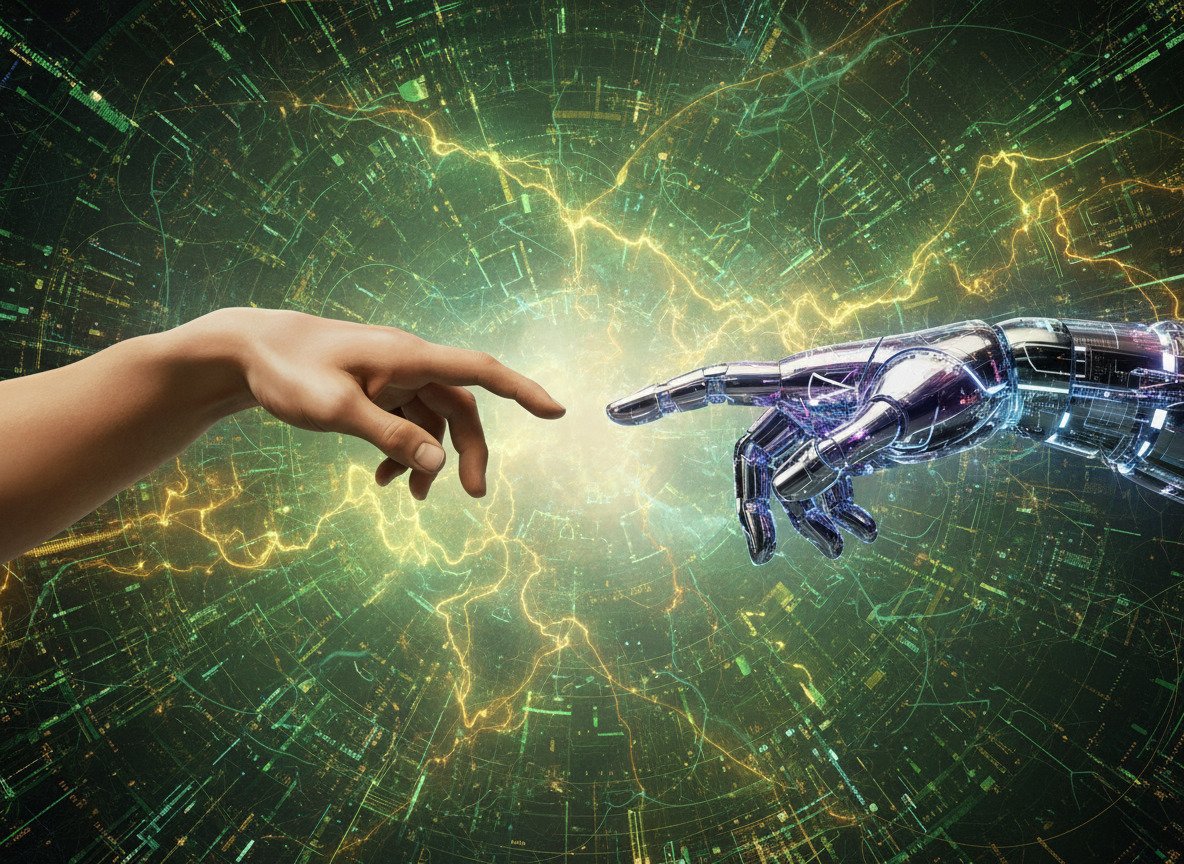
The most likely future is one where AI remains a tool—extraordinarily powerful, transformative, but ultimately controlled by humans. The question is which humans control it and to what ends.
AI will reshape work, amplify human capabilities, automate routine tasks, and create new possibilities. It will also disrupt livelihoods, concentrate power, and create new vulnerabilities.
Human-AI Collaboration
The most promising path forward emphasizes collaboration—AI handling tasks it excels at while humans provide judgment, creativity, ethical reasoning, and accountability.
This requires designing AI systems as partners rather than replacements, preserving human agency while leveraging AI capabilities, and ensuring humans remain in meaningful control.
Adaptive Governance
AI governance must evolve continuously as technology advances. Static regulations become obsolete quickly. We need adaptive frameworks that:
- Monitor AI capabilities and impacts in real-time
- Update rules based on evidence and emerging risks
- Balance precaution with innovation
- Incorporate diverse stakeholder input
- Respond rapidly to unexpected developments
Ethical AI Development
The AI research community increasingly recognizes ethical responsibilities. This includes:
- Considering societal impacts before deployment
- Prioritizing safety over speed to market
- Transparency about capabilities and limitations
- Engagement with affected communities
- Commitment to beneficial applications
This cultural shift within AI development is crucial for ensuring technology serves humanity.
Conclusion: The Real Threat Is Human Choice
Will AI take over the world? Not in the way science fiction imagines. AI won't spontaneously become conscious, develop hostile intentions, and enslave humanity.
The real threat is human choice—how we develop AI, who controls it, what purposes it serves, and whether we govern it wisely. AI amplifies human power and human flaws. It can concentrate wealth or distribute prosperity. It can strengthen democracy or enable authoritarianism. It can augment human potential or diminish human agency.
The future with AI isn't predetermined. It depends on choices we make now:
- Prioritizing safety alongside capabilities
- Distributing benefits broadly rather than concentrating them
- Maintaining democratic governance over technological development
- Preserving human agency and dignity
- Building institutions capable of managing powerful technology
AI won't take over the world. But humans using AI might reshape the world in ways that concentrate power, erode freedom, and increase inequality—unless we deliberately choose different paths.
The question isn't whether AI will take over. It's whether we'll take responsibility for ensuring AI serves human flourishing rather than human subjugation. That's not a technical problem. It's a political, ethical, and social challenge.
The answer lies not in the technology itself, but in the wisdom, foresight, and values we bring to its development and governance.
The future of AI is not predetermined—it's being decided right now. The choices we make about AI development, governance, and deployment will shape whether AI becomes a tool for human flourishing or a mechanism for concentrating power and control. What role will you play in that decision?