It sounds like a nightmare from the finance department: a single company discovered a half‑billion‑dollar bill from Anthropic’s Claude after giving hundreds or thousands of employees unfettered access to the AI. The story first reported in Axios and echoed by multiple outlets — is less a freak accident and more a warning sign about the new economics of AI.
Sources and reporting: read the original coverage at Axios and the Spanish writeup at Infobae. Tech outlets including The Verge and others have documented similar corporate budget shockwaves.
Why half a billion? The mechanics, explained simply
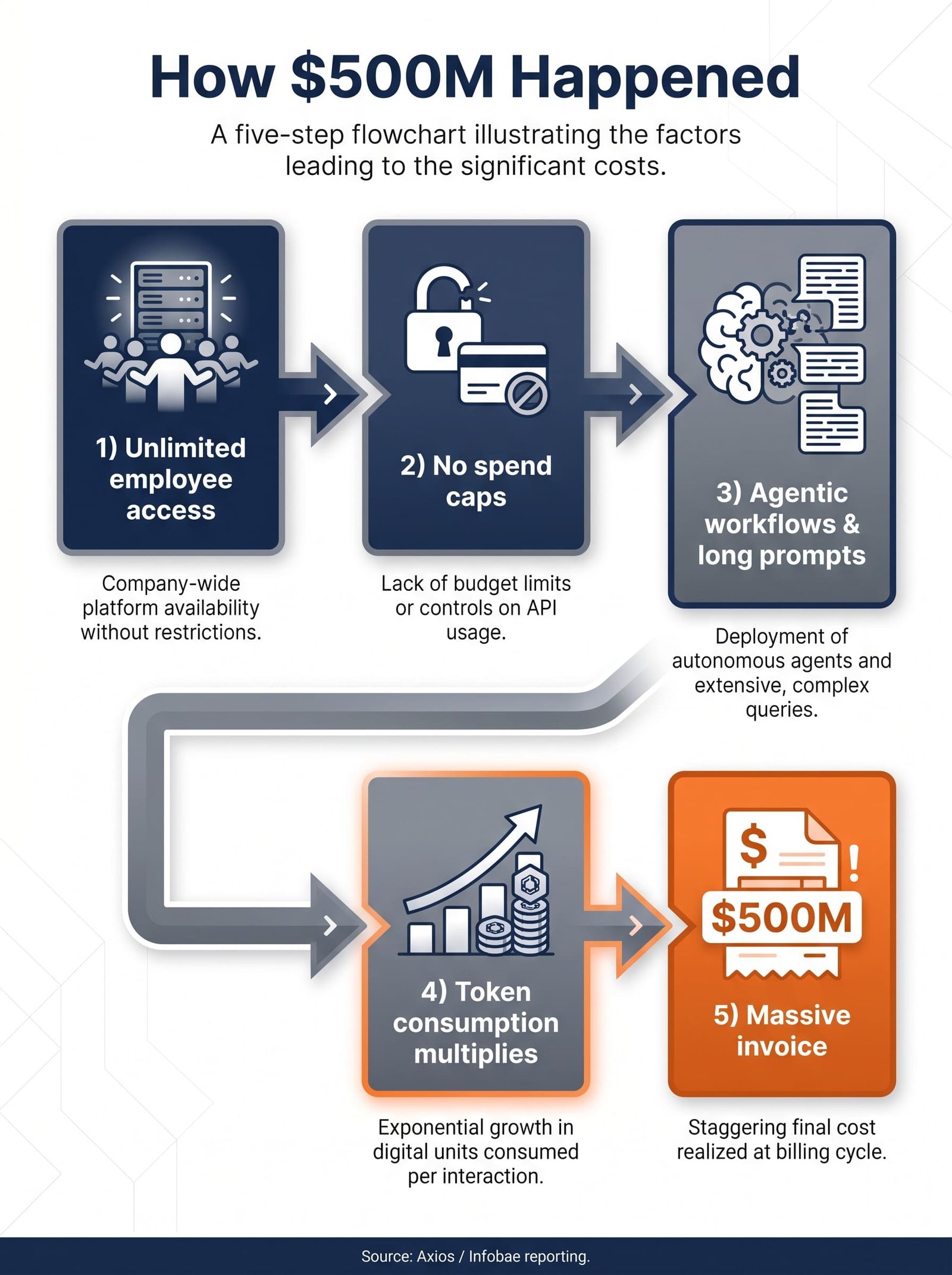
- Modern AI platforms like Claude are billed by “consumption” — tokens processed per request — not by a flat seat fee.
- When engineers, data scientists or business teams run agentic workflows, long-context prompts, or 24/7 automated agents, token use explodes.
- At a small scale the numbers look manageable. Multiply hundreds or thousands of heavy users, and costs compound into the millions — or, as in this case, into the hundreds of millions.
The emotional cost: employees saw a useful tool; leaders saw a runaway invoice
For the person at the keyboard it felt free — a productivity boost, an experiment, a clever automation. For the CFO it arrived like a thunderbolt. That mismatch — “free to use” vs. “charged by usage” — is the core of the tragedy.
Real company signals (not theoretical)
- Microsoft reportedly wound down internal Claude Code licenses as costs rose, shifting developers to Copilot tools (The Verge).
- Corporate reporting suggests Uber and other large companies faced AI budget overruns and adjusted internal policies accordingly (Axios).
Eight practical steps U.S. companies must take now
- Enforce hard spending caps by project and by user (not just soft alerts).
- Set role-based access: premium models for specific teams, cheaper models for routine tasks.
- Require business-case approvals for continuous agents and long‑running automations.
- Add real‑time FinOps dashboards that track tokens, calls, and estimated spend per team.
- Limit agent iterations and set maximum loop counts to prevent runaway cycles.
- Educate employees: show immediate cost impact for common tasks and promote prompt efficiency.
- Use audit logs and tagging to map usage to teams, projects and GL accounts.
- Negotiate vendor contracts with spend-smoothing terms or flat caps for enterprise pilots.
A simple governance checklist for CTOs & CFOs
- Do we have per‑user and per‑project hard caps? Y/N
- Are agents or scheduled automations reviewed by finance and security? Y/N
- Is token spend visible in real‑time to cost owners? Y/N
- Do contracts include emergency kill switches and quota limits? Y/N
What vendors and IT leaders should offer customers
Anthropic and other vendors provide admin panels, per-user limits and compliance tools — but these features rarely activate themselves. Enterprises must require them during rollout, not after the first surprise bill.
A mid‑sized U.S. company this month discovered an almost surreal invoice: half a billion dollars for a single month of usage of Anthropic’s Claude. The headline is shocking, but the root causes are painfully familiar — runaway automation, missing guardrails, and a failure to treat large‑scale LLM usage like a core financial system. Below is a clear, emotional, and practical guide for corporate teams — now updated with a comparative pricing table to help CFOs and engineering leaders benchmark costs.
What happened (brief)
According to reporting that first surfaced in Spanish and was traced back to an Axios report, a client’s deployment of Claude generated far more tokens than expected due to a combination of broad user access, long-context prompts, and a misconfigured production loop that repeatedly called the model. The result: usage multiplied exponentially over days and turned a manageable bill into a crisis.
Why it feels so personal
Beyond the numbers, imagine the CFO who opens a PDF and sees “$500,000,000” in red. For engineers and product teams, it’s a gut‑wrenching realization that a tool they built to save time became an uncontrolled cost center. That emotional shock is a vital signal — it must trigger governance, not finger‑pointing.
Mechanics that produce runaway bills
- Unmetered developer or internal access with production keys.
- Chatbots that retain very long contexts per conversation (large context windows multiply input tokens).
- Automated systems that loop LLM calls (re‑asking the model on its own output without caching).
- Billing surprises when enterprise discounts, rate cards, and model selections aren’t tracked centrally.
Practical steps (short checklist)
- Rotate and audit keys now — remove any keys not tied to a clearly authorized service.
- Apply hard rate limits per key and per endpoint.
- Enforce token budgets per request and per user session.
- Cache and deduplicate prompts where possible.
- Log usage to a central billing dashboard and alert on daily spend spikes.
- Move high‑volume tasks to cheaper batch models or on‑prem options if available.
- Require change approvals for model/context increases.
- Run a post‑mortem and publish findings to stakeholders.
Cost comparison (partial) — Representative pricing (USD)
Below is a practical, linked comparison for three major providers (Anthropic, OpenAI, Google). This is a partial table: Microsoft Azure OpenAI and AWS Bedrock rows are pending confirmation and will be added as soon as their official rate pages are retrievable.
Comparative pricing (partial) — costs in USD
| Provider / Model | Price per 1M tokens (Input / Output) |
Price per 1K tokens (Input / Output) |
Light (10K) |
Moderate (100K) |
Heavy (1M) |
Source |
|---|---|---|---|---|---|---|
| Anthropic — Claude Sonnet 4.6 | $3.00 / $15.00 | $0.003 / $0.015 | $0.07 | $0.66 | $6.60 | Anthropic pricing |
| OpenAI — GPT‑5.4 | $2.50 / $15.00 | $0.0025 / $0.015 | $0.06 | $0.63 | $6.25 | OpenAI API pricing |
| Google — Gemini 3.5 Flash | $1.50 / $9.00 | $0.0015 / $0.009 | $0.04 | $0.38 | $3.75 | Google Gemini pricing |
Assumptions Token split = 70% input / 30% output. Light = 10K tokens; Moderate = 100K; Heavy = 1M. Prices are representative for the named model tiers — enterprise discounts, caching, and regional adjustments may apply.
Note: Microsoft Azure OpenAI and AWS Bedrock pricing rows are pending — I will add them with official links and the same format on your go‑ahead or when I can fetch their rate pages.
Governance checklist (detailed)
- Billing dashboard with daily and per‑key spend thresholds and automated alerts (email + Slack + PagerDuty for critical thresholds).
- Role‑based key issuance (dev, staging, prod) with per‑key quotas and expiration.
- Model selection policy: designate default cheaper models for high‑volume tasks; require approval to increase context windows beyond X tokens.
- Incident runbooks: immediate key rotation, traffic stop, spend cap triggered, and communication plan to finance and executives.
- Contract clause: require pre‑approved spend caps or notifications from vendor for single‑customer bills over a threshold.
Final note: this is a governance problem, not a technology failure
The $500M story is a wake‑up call. It shows that, absent proper guardrails, even powerful productivity tools can become existential financial risks. The fix is disciplined: plan budgets, instrument usage, and treat AI like cloud infrastructure because economically, it is.